
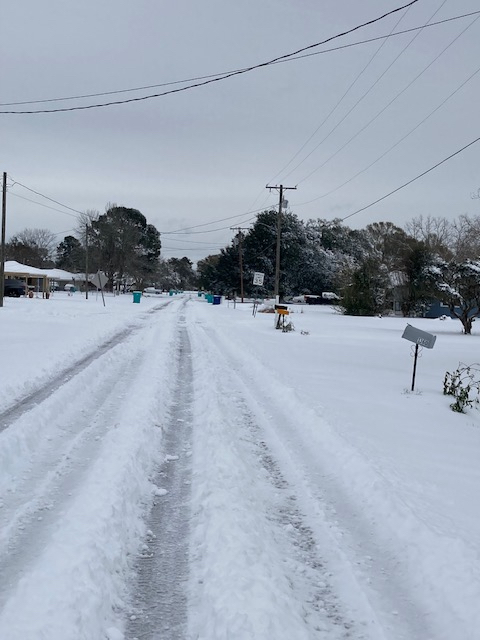
The past week’s extreme weather shows again that the end of January seems to be a favored time for south Louisiana to shiver under brutal temperatures and marvel at heavy snow, but the month doesn’t have exclusive chill rights.
The coldest weather in south Louisiana has come about, as it has this time, when cold, cold air plunges down from Canada. Most of the time the icy blast stops before it gets to us, but it seems to be a more frequent visitor in recent years. We get our biggest snowfalls when that cold air collides with warmer, moister air from the Gulf, which happens pretty often. If the snow doesn’t melt, it can make things still colder because it will reflect away most of the sun’s warming rays.
Just a year ago, an Arctic blast sent us sleet and snow on January 15, sending real temperatures into the 20s and wind chills into single digits. Opelousas registered a low of 15 degrees, Crowley saw 17 degrees and Abbeville dropped to 18. Temperatures fell to 21 as far south as Cameron and Berwick.
In 2022 the big freeze came in December, just in time for Christmas. We felt the coldest temperatures on the morning of December 23, and lows fell into the upper teens on Christmas Eve and Christmas mornings. The year before, icy weather in the middle of February 2021 sent even colder air ─ 12 degrees at DeRidder, 13 at Grand Coteau, 16 at Cameron, 17 at Abbeville. A cold front from the north ran into moist Gulf air on December 8, 2017, bringing a more than an inch of snow at Ville Platte and a half inch at Eunice, but four inches or more at places closer to the Gulf.
Mid-January was again favored in 2014. My notes for my home town of Washington show that snow and ice blanketed the town on January 28, 29, and 30, sending overnight temperatures into the teens and that the temperature stayed below freezing for practically all of that time. The town also got a dusting of snow in the early morning of January 24, when freezing temperatures lasted all that day and an icy mix of snow and rain closed schools and businesses. Two snows in two weeks are a real rarity.
Ville Platte saw more ice accumulation than some other towns during the winter storm that began on February 3, 2011. But all of south Louisiana saw at least a trace of freezing rain that clung to electric lines and caused widespread power outages. In 2010, bitterly cold Arctic air camped over south Louisiana on January 7, and stayed for several days Some communities stayed below freezing for more than 36 hours, from around midnight on January 8 through the afternoon of January 9. The cold was blamed for several house fires.
The snowfall on December 4, 2009, was said to be the earliest ever recorded in south Louisiana, and still is. Eunice got 3 inches. Ville Platte got 2, practically everybody got at least an inch. That was even earlier than the year before, when snow fell on December 11. Washington got 6 inches in 2008, Ville Platte got 5, Eunice got 3, Church Point saw 2½.
A big ice storm kept things frigid for three days in January 1997, with the usual effects, but also, according to a report from the Lake Charles weather office by Mark David Roth, an unexpected side effect was an areawide baby boom. Admissions at local hospitals were 150% of normal during August, September, and October.
The worst of the January freezes may have been 85 years ago. On January. 23, 1940, more than 10 inches of snow fell on some parts of south Louisiana. The Associated Press reported that day that “except in the coastal regions, Louisiana and Mississippi today are mantled in the heaviest snow in years, measuring from one to 13 inches.” Snow began to fall early on the morning of January 22, turning during the day into sleet, then into a cold rain.
That snap helped make January1940 the coldest month in south Louisiana history. Across the area, the temperature dropped below freezing on 22 of the month’s 31 nights, including a stretch of 17 consecutive nights beginning January15. Temperatures fell into the teens on five nights.
That 1940 freeze induced or worsened a flu outbreak that took several lives. E.A. McIlhenny reported “incalculable damage” to the Jungle Gardens at Avery Island. Cattlemen drove herds into the woods, where there was some shelter from a biting north wind. It didn’t save many cattle.
Everyone breathed a collective sigh of relief in early February, when, finally, the freezing gale from the north shifted to the south and brought warm winds from the Gulf. Nobody knew that in just a few months those gentle southerly breezes would turn into a hurricane that stalled on top of us. It caused one of our worst floods ever, making 1940 not only our coldest year on record, but also the wettest.
You can contact Jim Bradshaw at jimbradshaw4321@gmail.com or P.O. Box 1121, Washington LA 70589.