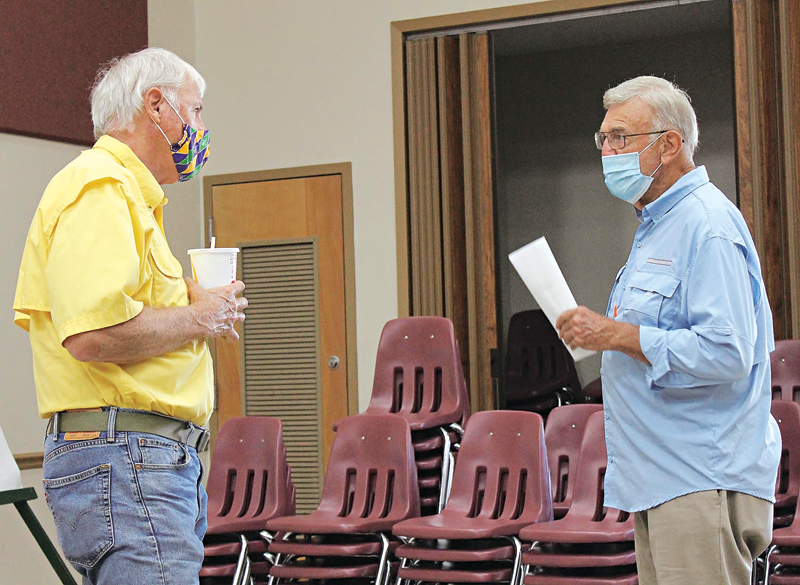
Police jurors wanted input from the public — specifically, from parish crawfish farmers — before they authorized aerial spraying for mosquitoes in Acadia. To that end, a public hearing was held Thursday night in the Community Room of the Cooperative Extension Office.
Mark Shirley, crawfish specialist with the LSU AgCenter, was asked to talk about crawfish and their susceptibility to the chemicals used to kill mosquitoes. It was hoped that crawfish farmers could add to the conversation with their experiences.
Only its rice harvesting time. Not a single crawfish farmer turned out for the meeting.
But that didn’t stop the meeting. “I talked to everybody in my district, except for the little ‘behind-the-house’ crawfish farmers, and they’re all for it (aerial spraying),” said Gordon Ray “G-Ray” Morgan, a member of the jury’s Mosquito Control Committee. “They said as long as we can do what they’re doing in Vermilion and Jeff Davis, they’re for it.”
Both of those parishes have combination truck and aerial spraying. The chemical used for the aerial spraying is Dibrom.
And while Shirley would not say that Dibrom was not toxic to crawfish, he said that crawfish are closely related to insects and insecticides kill insects.
“All of the pesticides approved by the Environmental Protection Agency and the U.S. Department of Agriculture are safe if used according to label,” Shirley said.
It was noted, however, that the Dibrom label includes, “This product is toxic to aquatic organisms, including fish and aquatic invertebrates.”
Shirley said he does occasionally get calls from crawfish farmers concerning dead crawfish but “most of the time, it’s not that plane that flew over or that truck that passed by.”
More times than not, he said, it’s low oxygen content in the water or a combination of low oxygen and a possible low dose of insecticide, adding, “I haven’t heard of any problems for the last five or six years.”
He said baby crawfish are most susceptible to insecticide and, unfortunately, baby crawfish are present right after fields “flood up,” when mosquito populations surge.
Shirley explained the life cycle of crawfish, noting that at this time of the year – July through September – most of the brood crawfish are underground protected in burrows.
Asked if this, then, would be the ideal time to spray aerially, he answered, “That would seem logical.”
The parish’s current contract for mosquito control includes a section on aerial spraying. The cost is 83 cents per acre plus cost of the chemical – estimated at 70 to 80 cents an acre. To spray a 10,000-acre tract would cost the parish $15,300. Acadia Parish is comprised of 420,000 acres.
“It’ll kill the mosquitoes when you spray, but the next morning they’ll be back,” Glenn Stokes, contractor for the parish, pointed out. “Neither Dibrom nor the chemical used in the spray trucks has any retention. They break down in a matter of hours.”
Stokes went on to say that, while some areas may be reporting “mosquito problems,” the number of mosquitoes is actually very low in Acadia Parish at this time.
“Acadia Parish has 65,000 people and we’re getting maybe two service calls a day,” he said. “The mosquito population is very low right now.”
“Apparently the districts are all different,” said Juror Walter Andrus. “Mr. Gordon seems to be having a problem in his district. Maybe we need to work on the people that are having a problem. Let’s take care of them.”
Andrus’ district is comprised mostly of the city of Crowley, which has its own mosquito control program. “I’m not having a problem with mosquitoes,” Andrus said.
Since this was a public hearing, no action was taken or recommended. However, jurors assured that the topic would be discussed again, possibly at the next committee meeting on Sept. 1.