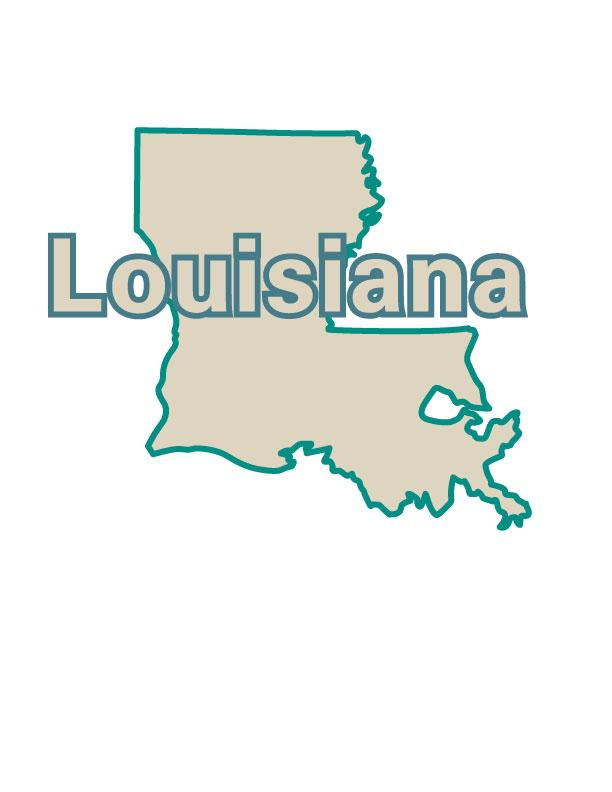
I knew that a number of parishes have been created from what was the sprawling district once called Imperial St. Landry, but while looking for something else the other day I came across a reminder that there was a serious, if short-lived, discussion of yet another one that most people have forgotten about.
St. Landry was called “Imperial” because it was originally the size of a small empire, including everything between the Atchafalaya and Sabine rivers on the east and west, and the bottom of Rapides and Vernon parishes and the tops of Lafayette and St. Martin on the north and south. It was cut in half in 1840, when everything west of the Mermentau River became part of Imperial Calcasieu Parish.
Imperial Calcasieu has since been carved up to form the current Calcasieu plus Cameron (formed in 1870), and Allen, Beauregard, and Jeff Davis parishes (all in 1912), and Acadia (1887) and Evangeline (1910) have been created from parts of the old Imperial St. Landry.
The push for another split began in late 1916 or early 1917, when a group of business leaders from Melville began to talk about creating the Parish of Atchafalaya along the eastern edge of St. Landry.
“There is no denying the fact that the Melville people would like to see a courthouse along the banks of the mighty and historic Atchafalaya river,” the Opelousas Star-Progress reported in February 1917. “There is no discounting the fact that the Fourth Ward, which is as large in area as the average parish of Louisiana, is destined to grow in population and wealth.”
Bad roads made the Fourth Ward “as far away from Opelousas as from New Orleans” in terms of the time it took to get to either place, proponents of Atchafalaya Parish said, reflecting one of the successful arguments advanced when Evangeline Parish was formed several years earlier.
The Star-Progress found “considerable interest” in Melville and the surrounding area in pushing for division, and the hometown Melville Tattler “warmly endorsed” the idea. But there was not so much interest elsewhere.
“Whether or not the movement will gain favor is a matter which time alone will settle,” the Star-Progress said. It was an open question whether “agitators for the creation” could get support for their plan to be approved in a parishwide vote.
“A disinterested party is bound to see something in the new movement,” in the Star-Progress’s opinion, but that wasn’t enough. It appears that most disinterested parties stayed disinterested.
A fictitious Parish of Atchafalaya has figured in several novels about south Louisiana and it has been one of the made-up parishes used in the Boys’ and Girls’ State conventions, but the real thing never was put to a vote.
That may have been at least partly because of natural opposition outside of Melville to further dividing the parish, but it could also have been because the town’s leaders were hugely distracted in the fall of 1917.
On October 11 fire destroyed 21 buildings in Melville, essentially the entire business district, and turned the focus to rebuilding the town, instead of putting up a new courthouse.
A collection of Jim Bradshaw’s columns, Cajuns and Other Characters, is now available from Pelican Publishing. You can contact him at jimbradshaw4321@gmail.com or P.O. Box 1121, Washington LA 70589.