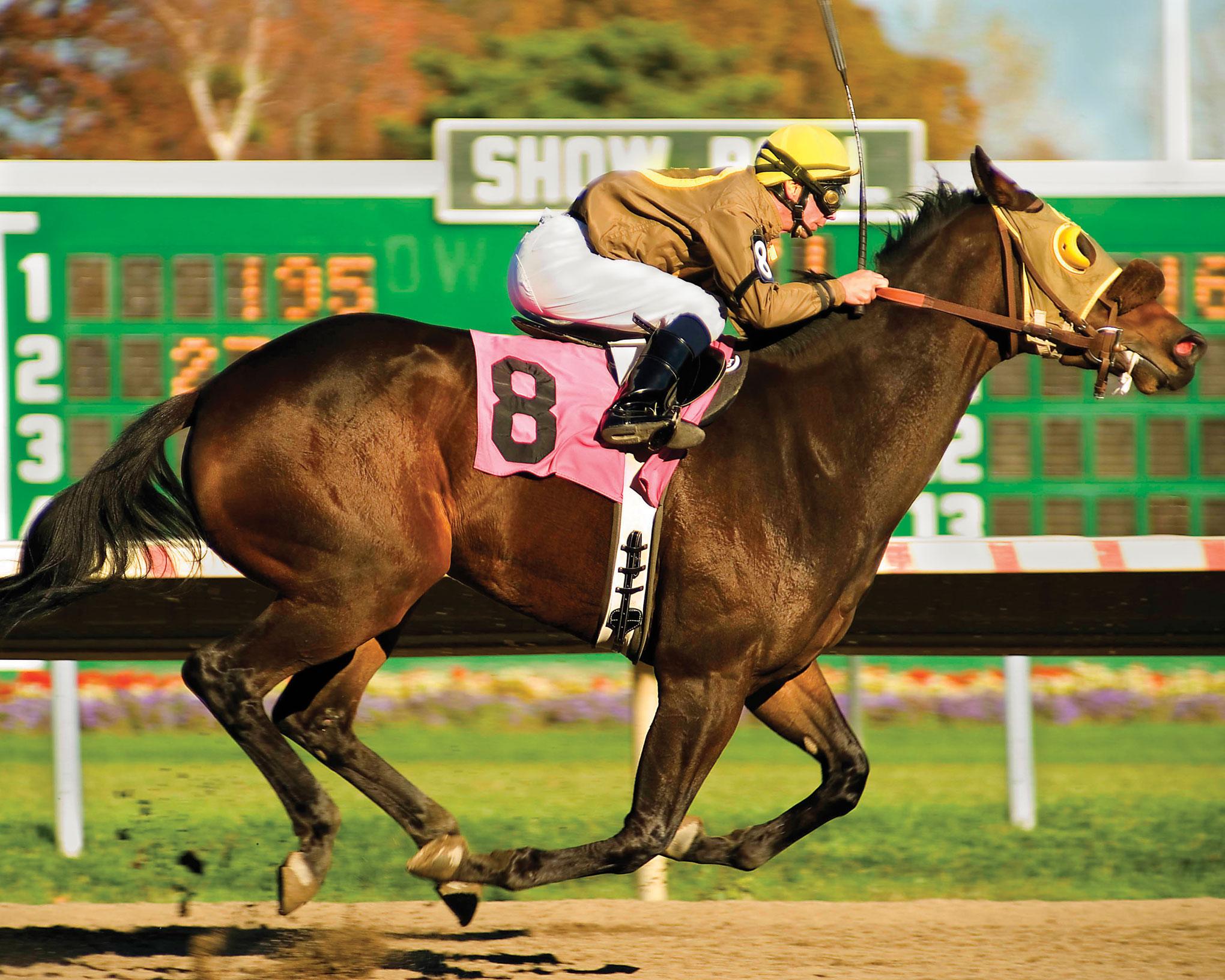
Blue Vee, ridden by Donald Comeaux, won the first race — a five-furlong claiming race for four-year-olds and up — when 10,000 people turned out for the opening of Evangeline Downs on April 28, 1966, 53 years ago this week.
The event was something to behold. Gov. John McKeithen, wearing a swanky plaid sports coat, cut the ribbon to officially open the $2 million facility in Lafayette. Frem Boustany, chairman of the board, welcomed the crowd to the track. Nearby were J. Alfred Begneaud, president of the board; D. S. (Shine) Young, secretary; and Muller Broussard, treasurer.
State Sen. Edgar Mouton Jr. was master of ceremonies for the ribbon-snipping. He was joined by a score of public officials that included State Sen. Sam Broussard; State Reps. J. Luke LeBlanc and Roderick Miller; Lafayette Police Jury President Overton (Pye) Menard; Lafayette Mayor J. Rayburn Bertrand; Carencro Mayor Andre Prejean; and Lafayette Sheriff W. E. (Dick) Harson.
Then, according to Lanny Thomas, who covered the event for the Lafayette Advertiser, “There was the traditional parade of jockeys … and the first race began. The first run intrigued the standing-room-only audience. … There were few triumphant screams when Blue Vee raced cross the winning line.”
But the ice was broken, and bettors went to the windows for the rest of the evening, and kept coming back.
In those early days before Delta Downs was built just a few miles from the state line, Evangeline Downs was the first place east of the Sabine River where a Texan could make a legitimate bet on a horse race. Tour buses by the dozen filled the parking lot every racing night, bringing so much betting money that armored cars had to haul the cash to the bank each night.
By Labor Day, the end of 1966 racing season, 277,556 fans had pushed through the Evangeline Downs turnstiles, and had pushed $12,058,936 through the betting windows.
Besides money, those early days also brought a memorable set of characters to the track.
I remember particularly Jimmy Hahn, who was the Racing Form reporter and a master of the colorful phrase, and Allen (Black Cat) Lacombe, who came straight out of a Damon Runyon story to become the track’s first PR man. “The Cat” had a million stories, told them a million times in his Irish Channel brogue, and had everybody laughing every time he did.
He was called the Black Cat because, he said, “if it wasn’t for bad luck, I wouldn’t have any luck at all.” Some others said he was called The Cat because he always landed on his feet. He ran for governor on a lark in 1959, somehow finished seventh in a field of 11 candidates, and, he claimed “while others spent jillions, I ended up $49 ahead.” His campaign slogan was “Run the squirrels out of office, keep the State safe for nuts.”
One of his greatest stories was about promotion of camel races around the pyramids when he visited Egypt courtesy of the U.S. Army. Another was about how he and a few other characters from Curley’s Neutral Corner, a bar on New Orleans’ Poydras Street, formed a company to bid on the security contract when the Superdome first opened. He said he was baffled when they didn’t get the job, “We knew everybody to watch for.”
Allen’s sidekick was Blaise Terranova, who made more money than most bettors by keeping an eye on the floor. He was known as a “stooper,” and made a living by picking up and cashing in winning tickets that had been accidentally or unknowingly thrown away by the uninitiated. I was always intrigued by his ability to turn over with the toe of his shoe tickets that had fallen face down on the floor.
Rae Woods, one of the track’s original employees, reminisced with me some years ago about how Blaise “could flip over a ticket with his toe quick as a wink, and could cover one end of the clubhouse to the other in 10 minutes.”
Johnny Birbiglia was Jimmy Hahn’s right-hand man. He was so thin that Jimmy said “he had to stand twice to make a shadow.” His chief responsibility was transmitting the race results to the Racing Form via an old-fashioned teletype machine. I think he may have been a Western Union man before he hooked up with the Form, but I well remember that he could make that clumsy old machine hum — error free.
Herb Cavalier, a former jockey who had been badly injured in a fall, was the track announcer when Evangeline Downs opened. Herb Holiday followed Cavalier in 1967 and Gene Griffin called the races for about 10 years beginning in 1970. Gene was the one that first used the French “Ils sont parti!” for “They’re off!”
The track went through some lean times after Delta Downs opened in 1973 and short-stopped those busloads of cash from Texas. The track moved to Opelousas in 2005 after Lafayette voters refused to allow video poker at the track, or anywhere in the parish.
But there was some history made in its heyday. Practically all of the Cajun jockeys who went on to win fame and fortune on the so-called “major” tracks got their start at Evangeline Downs. That list includes names like Robby Albarado, Ronnie Ardoin, Calvin Borel, Curt Bourque, Eddie Delahoussaye, Kent Desormeaux, Mark Guidry, Randy Romero, Shane Sellers and Ray Sibille.
Some of them began riding there when they were still too young to get into the clubhouse, which admitted only people over 18. Some of them liked riding so much they’d have ridden a camel around the courthouse, if The Cat did the promotion.
A collection of Jim Bradshaw’s columns, Cajuns and Other Characters, is now available from Pelican Publishing. You can contact him at jimbradshaw4321@gmail.com or P.O. Box 1121, Washington LA 70589.