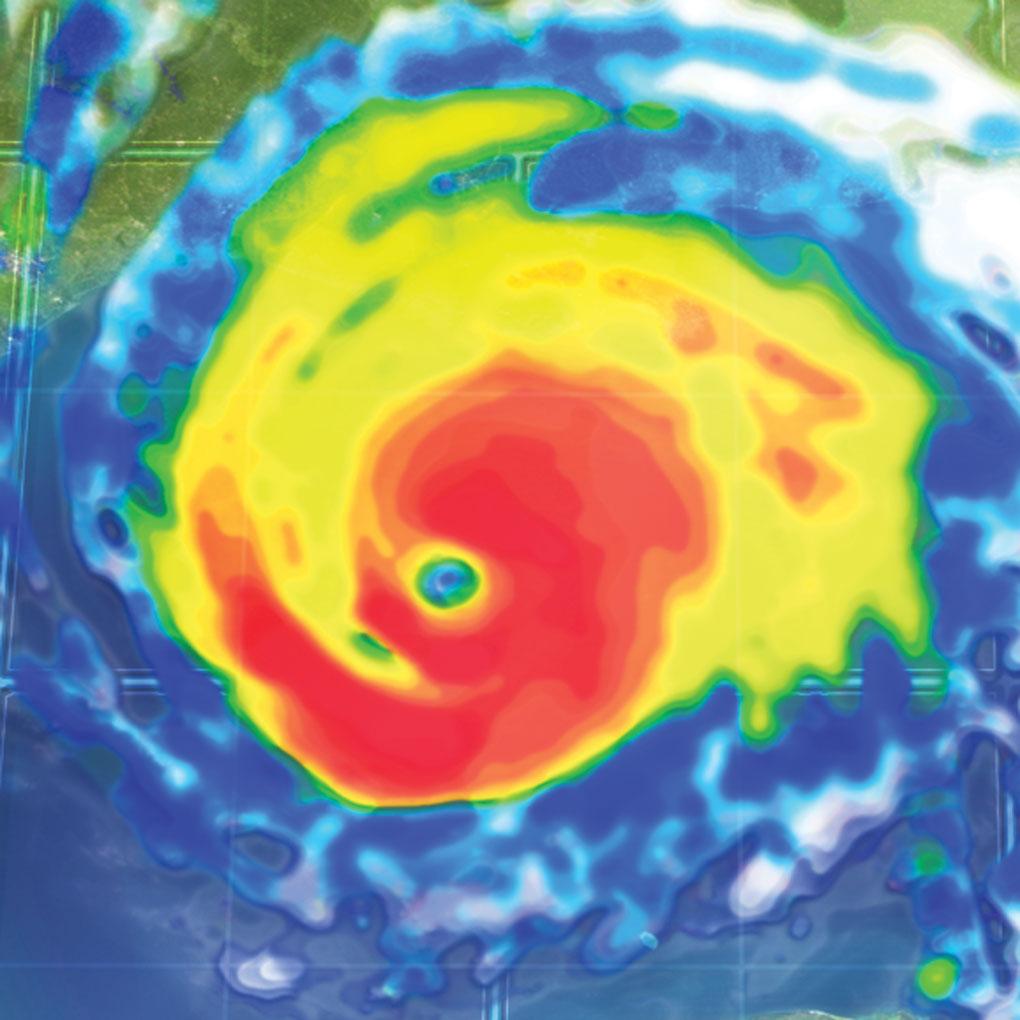
Federal meteorologists are predicting an average 2019 hurricane season, which begins June 1 and runs through November.
The National Oceanic and Atmospheric Administration said May 23 it expects nine to 15 named storms, of which four to eight would reach hurricane strength with winds at 74 mph or above. Between two and four of the hurricanes are predicted to reach Category 3 or higher, with winds 111 mph and up. Tropical storms have winds between 39 mph and 73 mph.
The first named storm of the year, Tropical Storm Andrea, formed this month ahead of the official start of the season but it never strengthened and quickly dissipated. The next systems will be named Barry, Chantal, Dorian, Erin and Ferdinand.
Two competing factors contributed to the “near-normal” forecast, acting NOAA administrator Neil Jacobs said. An El Niño effect will discourage formation of cyclones. El Niño systems send shearing winds into the Atlantic Ocean, and they break up storms. The effect is forecast to persist into the summer, helping tamp down storm formation, Jacobs said.
On the other hand, the surface of the ocean is warmer than average, and there are monsoon conditions in western Africa, which both increase the likelihood of storm formation, he continued said.
All told, the “near-normal” forecast is still just an estimate. NOAA is giving the weather a 40 percent chance of a typical season, a 30 percent chance it could be busy and another 30 percent chance this summer could be less active than usual, according to a news release.
The agency also does not predict how many storms will make landfall, Jacobs pointed out. Officials repeated their annual plea for residents to plan ahead for the coming season.
“It only takes one … to cause great destruction to a community,” said Daniel Kaniewski, acting deputy administrator for the Federal Emergency Management Agency.
He advised people to know evacuation routes and to assemble a kit with food and medicine to last 72 hours. The kit should also include a radio, and Kaniewski emphasized that people should also have cash on hand in case a storm knocks out electricity that powers ATMs and credit card readers. Finally, he reminded the public to purchase flood insurance to make it easier to clean up or rebuild after a storm.
Meteorologists have worked hard to improve their predictions, said Wilbur Ross, secretary of the U.S. Department of Commerce, which oversees NOAA.
The seven-day forecasts are now as accurate as the four-day forecasts were a few years ago, he noted. It’s a result of better software, algorithms, satellites and data-gathering equipment, Ross said.
Meteorologists typically exchange information and improve their models and gear during the off-season. However, non-federal scientists have said that the 35-day U.S. government shutdown last December and January impeded efforts to strengthen forecast tools, since many experts at NASA, the National Weather Service and elsewhere were furloughed.
The country as a whole endured a rough 2018 hurricane season, which included the devastating Hurricane Michael in the Florida Panhandle and Hurricane Florence, which ravaged the Carolinas. Louisiana, though, escaped unscathed. The season heated up toward the end, which was good news for Louisiana. The state is most susceptible to storms earlier in the season, state climatologist Barry Keim explained last November.