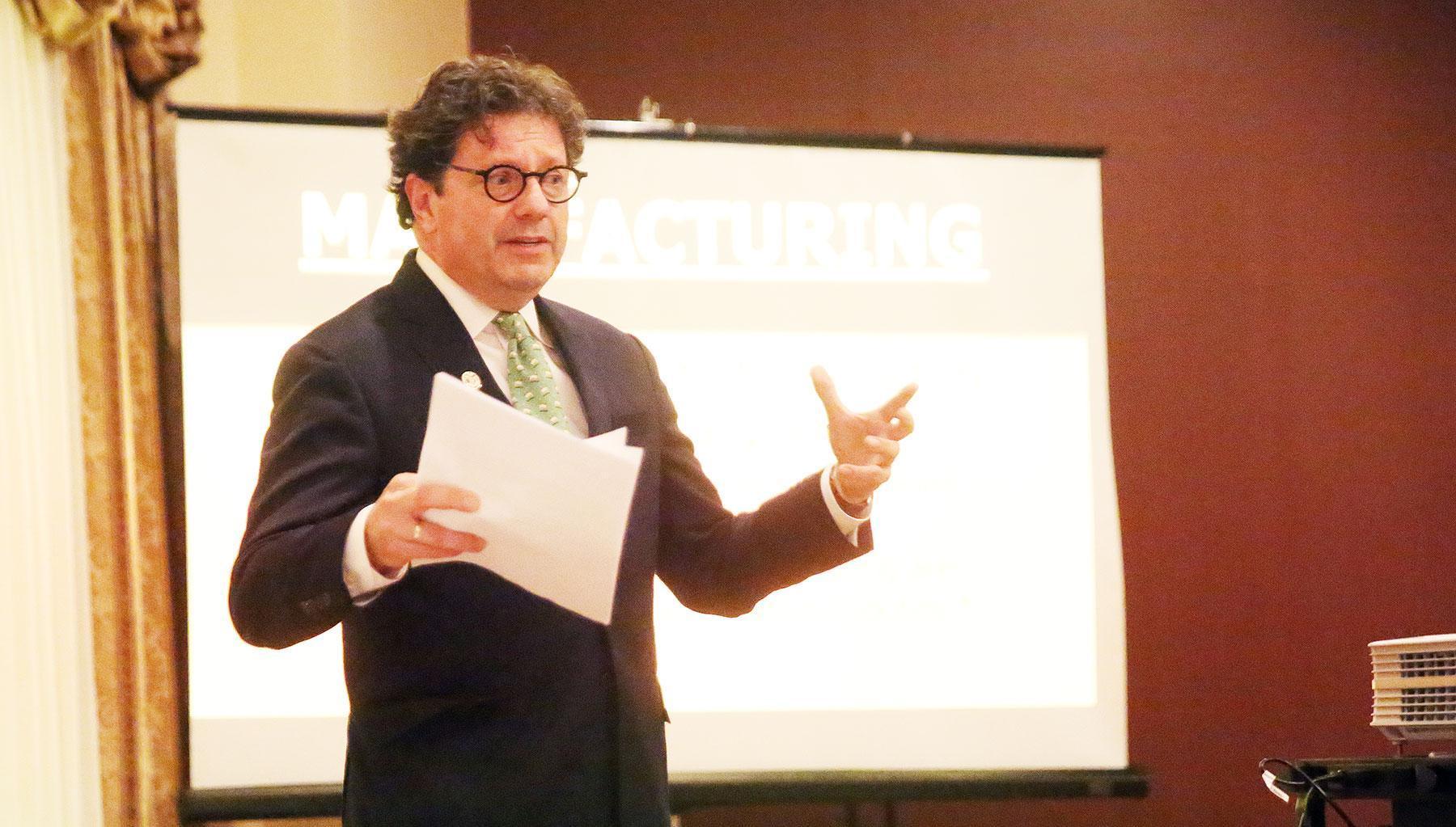
Tulane professor Peter Ricchiuti says some parts of the economy are doing well. Some show trouble signs. And some are just weird.
Ricchiuti, Tulane’s William B. Burkenroad Jr. Clinical Professor, gave his high-energy presentation on the economy and investment opportunities Tuesday to the local American Petroleum Industry chapter at the Petroleum Club of Morgan City.
His rapid-fire takes on bond yields, the national debt and more were punctuated by zingers.
“Give a man a fish, and he eats for a day,” Ricchiuti said. “Give a fish a man, and he eats for like 2-1/2 months.”
Ricchiuti opened by talking about the Permian Basin, the geological formation in Texas and New Mexico where oil reserves are counted in the tens of billions of barrels. Production in the Permian helped U.S. crude oil output grow from 5.5 million barrels a day in November 2009 to 12.9 million barrels last month, according to the U.S. Energy Information Administration.
That growth shifted the industry’s focus away from offshore and drove down prices, to St. Mary’s economic detriment.
Ricchiuti said investors are beginning to realize that while production is up, profits aren’t. Big-name money men including Warren Buffet and Carl Icahn are seeing energy as an investment opportunity after a bad 2019 for energy stocks.
And the industry may be looking for other pools of oil, maybe including the Gulf.
Also Tuesday, Ricchiuti said:
—There are mixed signals about the likelihood of recession.
One historic indicator of approaching recession is the inverted yield curve, a situation in which the yield for short-term debt is greater than for long-term debt. We’re not there yet, Ricchiuti said, but we’re close
He also pointed to a quirky indicator: recreational vehicle sales. Declining RV sales were seen before the 2001 and 2007-08 recessions. Sales were down 22% last year.
—For the first time, the national debt, now at $22 trillion, is larger than the nation’s gross domestic product, the total value of goods and services.
Traditionally, Ricchiuti said, debt grows in bad economic times and decreases as the economy recovers
“We now have a very high debt at a time when the economy is growing,” he said. “That’s very scary.”
—If you want to know which way interest rates are headed, measure the height of the Federal Reserve chairman.
For this indicator, offered for comic relief, Ricchiuti showed a chart developed by Tacit Management Inc. It shows the highest interest rates in the late 1970s under Paul Volker, a healthy 6-footer, gradually declining along with the heights of Alan Greenspan and Ben Bernanke. Rates dropped to their lowest point under Janet Yellen, who is a shade under 5 feet.
The current Fed chairman, Jerome Powell, is 6 feet tall.