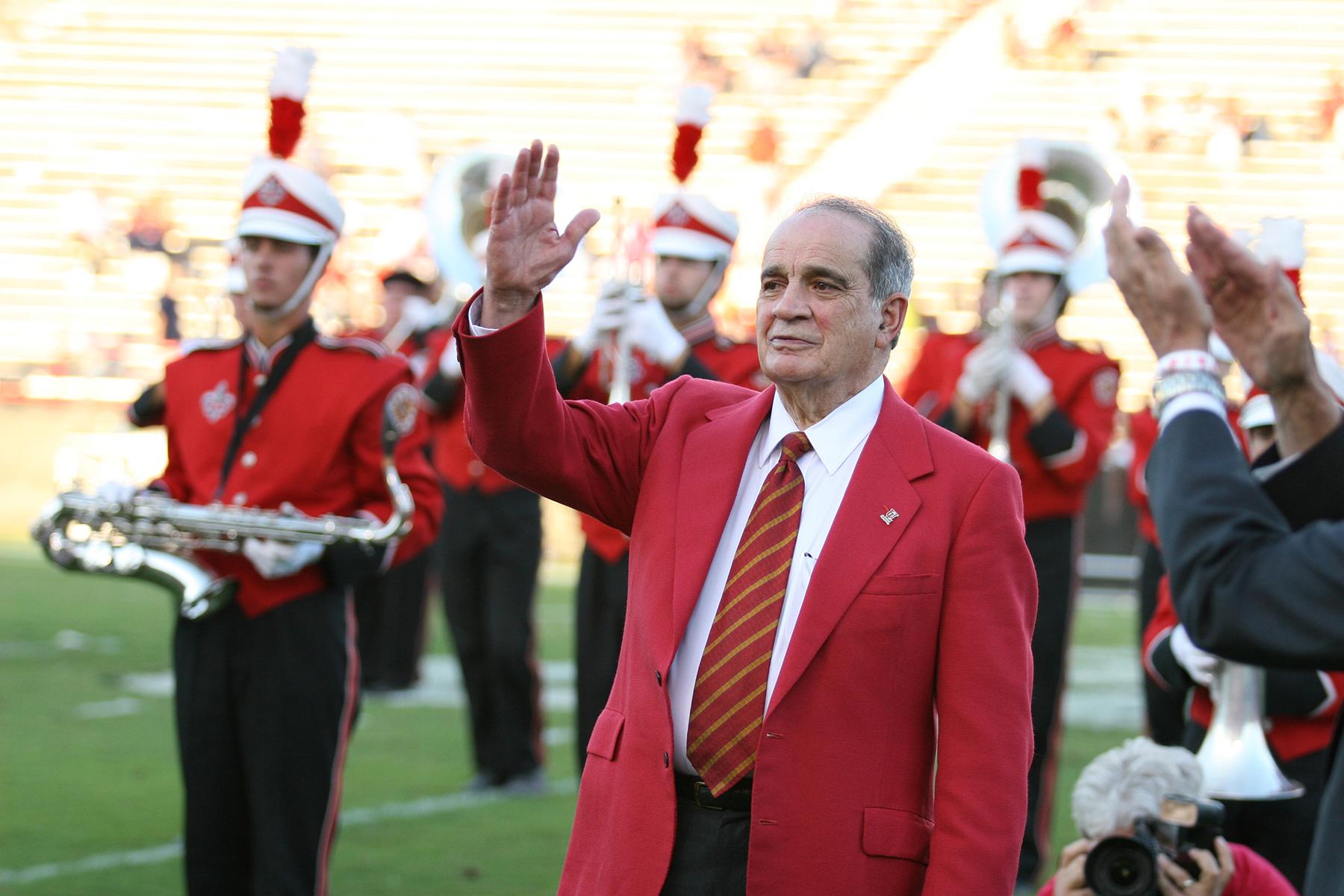
Anyone compiling a list of the men and women who most influenced the growth and character of south Louisiana would certainly have to put Ray Authement well toward the top.
He died April 5 at the age of 91 and is being remembered as the president who over three decades led the University of Louisiana to national prominence.
That alone was a remarkable achievement, but his vision and leadership extended far beyond the school he fell in love with at first sight. He recognized that the university’s most important role is as an academic institution, but that it also is an integral part of the whole fabric of south Louisiana.
His successor, Joseph Savoie, characterized him as a man whose dedication, determination, and selflessness “changed how the university saw itself and how others perceived it.” That’s a nice way of saying that Ray Authement had a vision for the university that not everyone could see — or was willing to accept — and that he could be stubborn as a mule in defending it.
In some respects, he was an unlikely university president. He was the first person in his family to go to college and bragged in an interview when he retired in 2008 that he was the best mathematician ever to graduate from Boudreaux Canal Elementary School (also the only one).
That distinction will likely stand, because today there is little but marsh grass in the tiny settlement 20 miles south of Houma where he was reared. His introduction to math was counting pelts trappers brought to the store run by his father. By the age of 10 he was keeping the books for his father and grandfather, who was a butcher.
He liked doing that, and took “all of the math classes they taught” when he got to Terrebonne High School. He was a student at Terrebonne when, he said, he fell in love with what was then Southwestern Louisiana Institute.
“I came for … a speech tournament … and I just fell in love and came here [to college],” he said. He graduated in 1950 with a bachelor’s degree in physics, went to LSU for his master’s and doctor’s degrees in math, taught for several years in other places, and returned in 1957 to teach math in “Little Abbeville,” a cluster of war surplus buildings far in the back of the campus.
He taught for 11 years and had to be talked into moving “up front” to become vice president. Clyde Rougeou, who was president then, promised to build a new math building if he took the job.
Rougeou retired at the end of 1973 and the reluctant vice president became the new, visionary president. He led the university for more than 30 years, perhaps most memorably during the 1980s, when an oil industry crash caused a massive financial crisis. As people moved away, businesses shuttered, thousands were laid off, and the budget for the university itself sliced thin, he found ways to support the economy and, perhaps more important, to help south Louisiana begin to believe in itself again and in its ability to recover.
During that time he created a dozen or more research centers focused on developing and diversifying south Louisiana’s economy, and poured whatever resources he could into them.
Those centers helped lead the way back, and also helped USL become the first Louisiana university to be designated a high intensity research institution — a prestigious distinction shared only by schools such as Carnegie Mellon, Stanford, and the like.
That was the first step in establishing the University Research Park, also a Louisiana first, on land that was once used to graze the school’s dairy herd. He said in 2008 that the park might be considered his greatest legacy as president. But then he thought about that a little more.
The best legacy, he said was in “so many bright and successful students” who passed through the school. Some of them had challenges, he said, “and you help them along the way, and it really leaves good memories.”
He did a lot of that. I know, because I was one of those students challenged by academia who he “helped along the way.”
It was my good fortune to enjoy his friendship and wise counsel for more than 40 years, and when I think about what he has done for south Louisiana, for the university, and for me and so many other students, the memories are indeed good — of a brilliant, caring, remarkable man.
A collection of Jim Bradshaw’s columns, Cajuns and Other Characters, is now available from Pelican Publishing. You can contact him at jimbradshaw4321@gmail.com or P.O. Box 1121, Washington LA 70589.