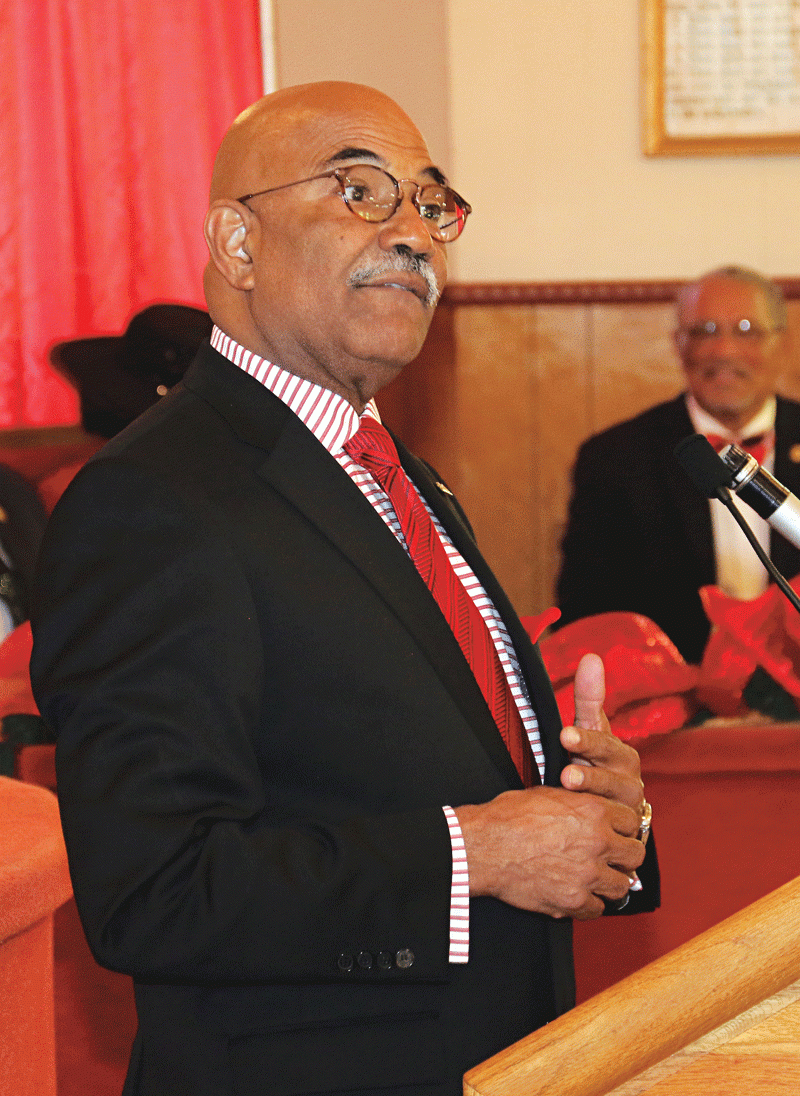
The following is the text of a speech given by Michael Victorian at the 32nd annual Martin Luther King Jr. City-Wide Celebration on Jan. 14 at the New Zion Baptist Church.
A native of Eunice, Victorian is the immediate past-president and chairman of the Board of the 100 Black Men of Metro Baton Rouge, and a senior client executive at CMA Technology Solutions. Prior to joining CMA Technology Solutions, Victorian worked at IBM for more than 30 years in sales and marketing.
...
I personally would like to thank this committee for granting me the privilege to share in your Martin Luther King celebration. I must admit I have had a nervous excitement since first receiving your invitation to deliver this message back to my beloved village. This village that nurtured and cultivated me into the man I am today, this village that shared in my victories and supported me in my defeats.
So, I stand before you today honored as a son of this community and as a solider of this fight that we face. Yes, I used the word fight.
Our nation, our state and our communities are in a fight for its future. Our country is more divided now than ever before – blue states versus red states; liberals versus conservatives; left versus right; Democrats versus Republicans; White versus Black.
Black America is in a fight like never, fighting against oppressions known and unknown. And we are especially in a fight for the future of our youth.
You see behind every heartbreaking fact concerning our youth is a face. Behind every tragic statistic is a story. Behind every upsetting catch phrase is a young person whose future will be lost if something is not done immediately to change his or her reality. And when it comes to young, African American men, the numbers are staggering and the reality is sobering. Young Black men, across the board, score below their counterparts in other racial and ethnic groups when it comes to graduation rates, literacy rates and college preparedness. And many African American men, in turn, are virtually locked out of employment and are filling up the nation’s prisons in disproportionate numbers.
Allow me you share a few facts:
— 54 percent of African Americans graduate from high school, compared to more than 75 percent of white and Asian students.
— Nationally, African American male students in grades K-12 were nearly 2½ times as likely to be suspended from school as white students.
— On average, African American 12th-grade students read at the same level as eighth-grade white students.
— The majority of the 2.3 million people incarcerated in U.S. prisons and jails are people of color.
Now let’s catch our breath for a second since that was merely and introduction. Those of you who know me well, know I am not a doom and gloom kind of guy. However, I just needed to set the context, for why strong men need to keep a-coming and why it takes a village to raise up a nation, but more precisely why we need Strong Black Men in our communities to save our villages.
Now my friends, rest assured I totally understand that at 3:40 p.m. the Who Dat Nation’s team takes the field.
So, I make the same promise to you that the late Elizabeth Taylor use to make to each of her new husbands — I promise not to hold you long.
When thinking of what to say, I thought I would follow the Baptist preacher model and give you three points and then take my seat. I’m going to give you my three points up front.
Just one note, since there are always detractors among us. My prayer is that my words will ignite a flame in both the men and women here today. But ladies, I want you to understand that I thank you for being the oil to our lamps and the carrier of our civilization and I appreciate fully that the Black man came from the first woman. And that women are Goddesses and the most beautiful creature on the planet, and you have the perfect attitude, behavior, strength, intelligence, resilience, soul, you are made up of beautiful diverse complexions, and shapes and curves that makes you impeccable.
However, today, I need to focus on the men.
So here are my three points up front:
— Legacy of the Strong Men who have Come before us and their impact on the Village.
— Finding Strong Men to accept the Challenges of today’s Village.
— Fathering the Strong Men for tomorrow’s Village.
As I share with you today, I do so from two facets of who I am. Since that is truly the only person I can honestly speak for. First being a product of this village, which has been, without a doubt, my greatest source of support from a legacy of strong men who instilled both pride and inspiration within me. Secondly, is that I am a proud Black Man, that fully understands that society has never overlooked the fact that I am a Black Man regardless of my achievements.
Today as we celebrate Dr. Martin Luther King Jr, who dedicated his life to the struggle for racial equality in this country and as well as celebrating his achievements that opened doors that particularly benefited not only my generation but allow me personally to participate and enjoy opportunities that were never even imagined by most person of color before.
As thankful as we are, we must realize that having the door opened creates the opportunity, but being prepared once you cross the threshold is what creates success. Therefore, I am thankful for the legacy of the good men of my village that fortified, inspired, motivated and implanted the tools within me not only to compete but to succeed once I was allowed in the room.
Strong men like Mr. Willie Baldwin, who taught me on the little league baseball field and in my Sunday school class that you must learn to maintain your cool if you want to stay in the game and play.
Men like Matthew Ned and Fred Dupre Jr. who showed me that it’s OK for a young black boy to excel in Math.
Men like Charlie Loeb who explained to me that you must be at the table to effect and influence positive policy change.
Jonas Mason, who preached the importance of how you dress and present yourself is not only a first impression but a lasting one.
Mr Willie Johnson who I would see go out every day and work, no matter how hard and provide for the needs of his family.
Roy Batiste who showed me that humility is a virtue of good man.
Coach Albert Taylor, Gerald Hardy and Freddie Alfred who taught me that it’s OK to win, but win with integrity.
Alvin Owens Sr. who showed me that service to others is our obligation to one another as human beings.
Rev. J. G. Frank, who as my pastor and leader who stood and fought for me to have a second chance even when I had been reckless in my own actions.
I could name countless numbers of males in this community that served as role models for me but we only have afternoon.
As I we move forward allow me to share just one quick anecdotes.
...
I have been to Minden, La., only twice in my life once to participate and support Thomas as his mentee at the Louisiana Youth Challenge. The first time, I was an uncertain early 20-year -old who needed 12 hours to finish college and faced with what do I do with my life, and on that trip to Minden, I was driven there by Clifton “Bro” Lemelle, Michael Dupre and the late Clifton “Mimo” Ned as they influenced the then Public Service Commission to open the door for me to be hired as the first black person in the marketing/sales department of Gulf States Utilities, which allow me to complete my last 12 hours of college needed to graduate, which then allow me to be hired by IBM that opened an entire different world to me.
So that trip to Minden to support Thomas was simply a payment on a debt.
This Village like so many villages are filled with Strong Men walking around you every day that represent all types of professions and backgrounds, that only need reminding that if they are truly honest with themselves, that somewhere on their Damascus Road experience there was a man or men that impacted their life and made them the person they are today and they have an obligation to repay that debt to have a positive impact on some child’s life.
You see as the immediate past president of 100 Black Men of Metro Baton Rouge and more importantly as a Board Member of 100 Black Men of America, that represents over 100 chapters in the continental United States, Europe and the Caribbean, we believe that the work of the 100 with young Black boys, Black college males and fully matured Black men is built on the premises that African-American males will respond most effectively from more favorable engagements with other African-American males.
Now we also understand that “every one of our color is not of our kind and every one of our kind is not of our color.”
Members of the majority community: Your presence reaffirms, Dr. Martin Luther King Jr.’s dream, goal and prayer are possible, in us sharing and working together as partners for the upliftment of our beloved community and especially for those who have been and are currently suffering from social and economic injustices so we can make this a better world for everyone to live in.
Still, as Black Men we have a responsibility to serve our community and be role models in our commitment to raising young boys to be the men of our future village. Because what they see is what they will be.
We are keenly aware that as rewarding as mentoring a young person is, it can be the most frustrating and thankless missions you have been entrusted with, however it can’t be limited to giving a few speeches and shaking hands. It’s about sharing our experiences with young people, and providing them a listening ear. It is about assuring them that we are here for them for the long haul. As Dr. Martin Luther King Jr., stated, “Life’s most persistent and urgent question is ‘What are you doing for others.’”
I know most of you are extremely busy men.
I understand your son has football in the fall, but can you pinch hit with helping another young man in the Spring. I understand your church has Bible study on Wednesday nights and your daughter has ballet on Thursday nights, but can you share a Saturday morning with a young boy who has never experienced a Black male reading to him.
Our Village needs men. strong black men who are willing to stand in the gap and to empower our youth to reach their full potential, so they become the next leaders in our community and compete in a global economy.
Our Village needs strong black men and to ensure that no child’s future is determined by their color, economic status or zip code.
Finally, ladies and gentlemen: The hope of our community rests in our successfully and selflessly building bridges across the generations. We need to find and follow strong men who are bridge builders that have a charge to keep if we are to advance the dream of Rev. Dr. Martin Luther King Jr.
The Bridge Builder
By Will Allen Dromgoolev 1860–1934
An old man going a lone highway,
Came, at the evening cold and gray,
To a chasm vast and deep and wide.
Through which was flowing a sullen tide
The old man crossed in the twilight dim,
The sullen stream had no fear for him;
And yet he turned when safe on the other side
And built a bridge to span the tide.
“Old man,” said a fellow pilgrim near,
“You are wasting your strength with building here;
Your journey will end with the ending day,
You never again must pass this way;
You’ve crossed the chasm, deep and wide,
Why build this bridge at evening tide?”
The builder lifted his old gray head;
“Good friend, in the path I have come,” he said,
“There followed after me to-day
A youth whose feet must pass this way.
This chasm that has been naught to me
To that fair-haired youth may a pitfall be;
He, too, must cross in the twilight dim;
Good friend, I am building this bridge for him!”