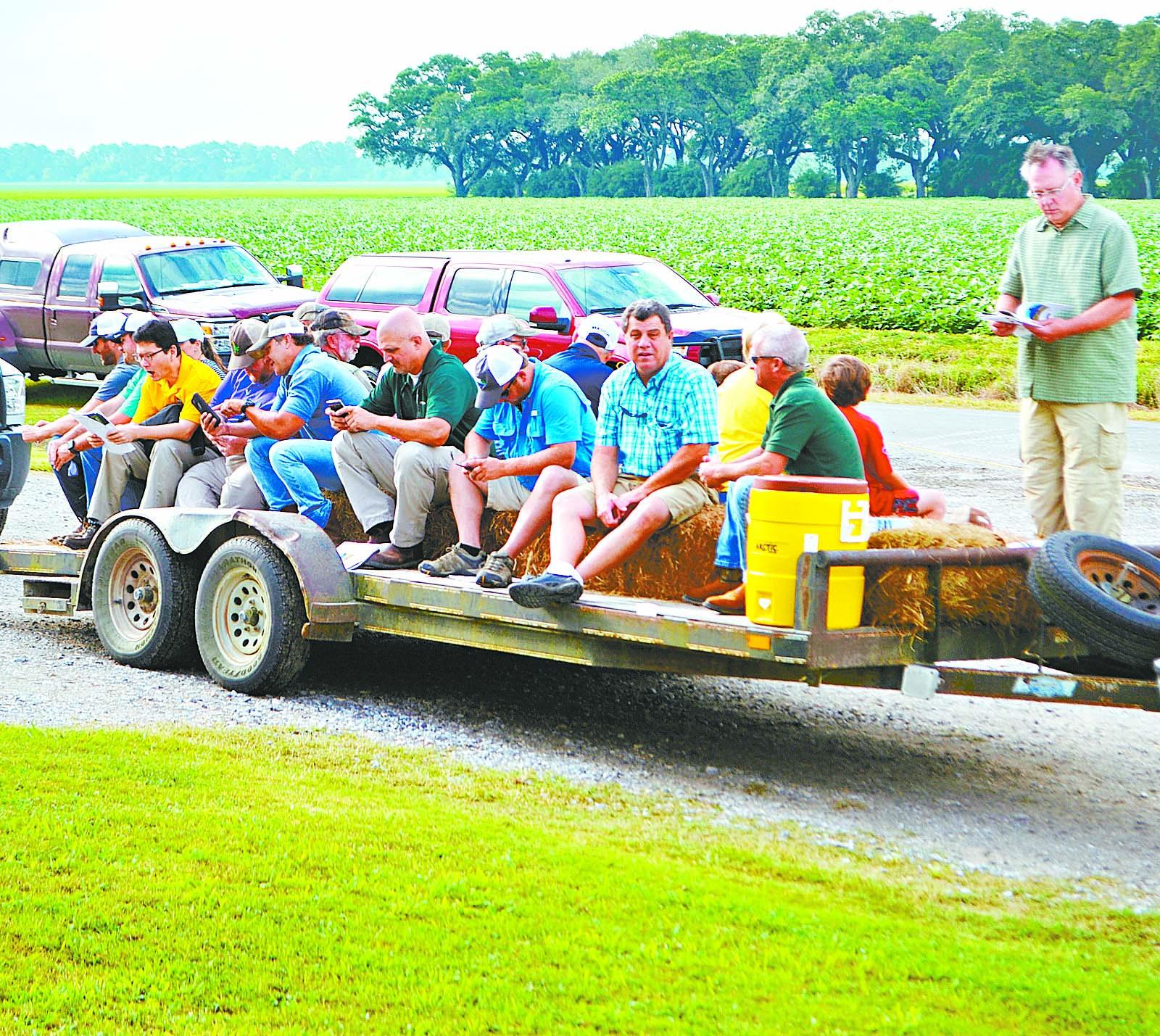
CROWLEY – If you were fortunate to hop on a trailer for the field tour Wednesday, you got an inside look at the continued work of many at the H. Rouse Caffey Rice Research Station.
From 7:15 a.m. to 9 a.m., tours left intermittently to tour the fields and learn more about various research. First stop was Drs. Eric Webster and Ben McKnight talking about rice weed control.
The duo explained their work with Provisia herbicide plus herbicides with broadleaf activity mixtures, broad spectrum weed control with dow herbicide loyant and evaluations of experirmental herbicides such as benzobicyclon and much more.
Regarding Provisia herbicide, Webster and McKnight’s research shows that 88 to 95 percent of weedy rice and barnyardgrass were controlled at the rice research station here as well as the Northeast Research Station at the 15 and 30 days after treatment levels. They also learned through many trials that a second application of Provisia was needed to overcome antagonism.
Second on the tour agenda was Drs. Steve Linscombe and Adam Famoso speaking about rice breeding.
Though Linscombe also serves as director of the H. Rouse Caffey Rice Research Station, his work has always been focused on rice breeding. The 2017 field day was dedicated to Linscombe. Linscombe, a native of Gueydan, will be officially retiring as of Oct. 1.
“Words cannot express how deeply he will be missed by the faculty and staff of H. Rouse Caffey Rice Research Station, the LSU AgCenter as a whole, and the entire rice industry. Thank you Steve for all of your hard work, dedication, and commitment to the rice industry,” read the dedication in this year’s program.
Linscombe career has been a successful one, to put it mildly, he has seen 33 rice cultivars released, dating back to 1991’s release of the long grain “Lacassine” all the way to 2017’s long grain release “PVL01”. Others released include:
— 1992: Bengal (medium) and Cypress (long)
— 1994: Jodon (long)
— 1995: Dellrose (long – aromatic)
— 1996: Lafitte (medium)
— 1998: Cocodrie (long)
— 1999: Dellmati (long – aromatic)
— 2000: Earl (medium)
— 2001: CL121 and CL141 (both long)
— 2002: CL161 (long)
— 2003: Cheniere (long) and Pirogue (short)
— 2004: Ecrevisse (short)
— 2005: CL131 and Trenasse (both long) and Jupiter (medium)
— 2008: Catahoula and CL151 (both long) and Neptune (medium)
— 2009: CL111 (long), CL261 (medium) and Jazzman (long – aromatic)
— 1010: Caffey (medium), CL152 (long) and Jazzman-2 (long – aromatic)
— 2012: Della-2 (long – aromatic) and Mermentau (long)
— 2013: CL271 (medium)
— 2015: CL153 (long) and CL272 (medium)
According to statistics in the dedication, these 33 new varieties have dominated the southern U.S. rice acreage over the last 20 years. The average rice yield in Louisiana has also increased from 4,500 pounds per acre in 1988 to an estimated 7,500 pounds per acre in 2014. A conservative estimate on the value of these varieties to the U.S. rice industry, though not directly linked to the increase but definitely a contributor, is well over $1 billion.
Linscombe, however, continues to work toward that retirement and he and others discussed the 37 varieties the group continues to work with.
Other stops on the field tour included rice pathology (Drs. Don Groth and Clayton Hollier), rice entomology (Drs. Michael Stout and Blake Wilson), rice hybrid breeding and drone demonstration (Brady Williams and Dr. James Oard) and rice agronomy (Drs. Dustin Harrell and Bobby Golden).
Meanwhile, the annual “poster session” offered a different look at various research aspects as well as the latest from around the rice industry including agencies like Farm Service Agency, USA Rice and Ducks Unlimited and equipment providers and much more. LSU’s College of Agriculture was also on hand to explain its program as well as talk about its mentor program.
Finally on the day’s agenda was the official program with comments from the Louisiana Rice Research Board, an update on the rice market and from USA Rice, discussion of the sustainability of U.S. rice production and finally remarks from Dr. William B. Richardson, vice president for agriculture with the LSU AgCenter, and Dr. B. Rogers Leonard, associate vice president with the LSU AgCenter.