
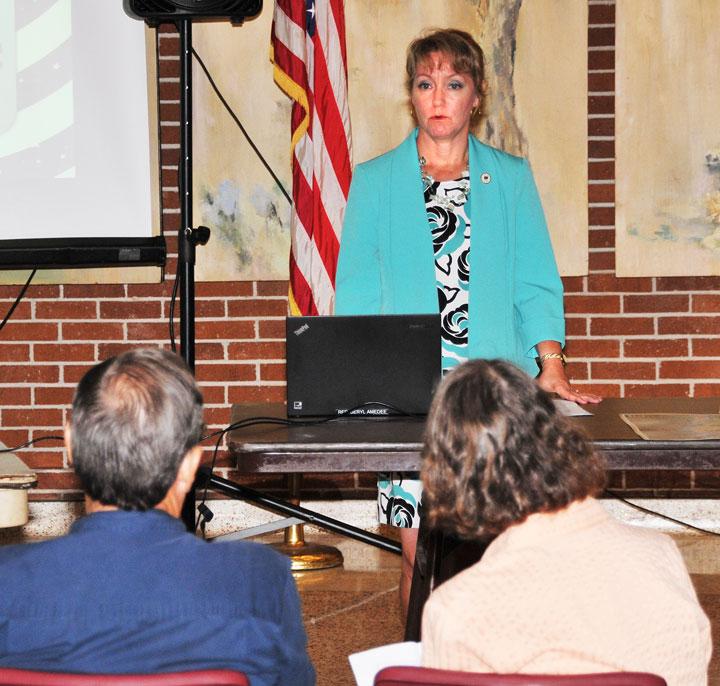
Louisiana legislators have lots of work to do to identify funding sources for the state to survive the more than $1 billion fiscal cliff projected for its 2018-19 fiscal year, state Rep. Beryl Amedee, R-Houma, said.
Amedee held a town hall meeting on Aug. 17 at the Morgan City Municipal Auditorium.
Louisiana’s 2017 regular legislative session began April 8 and ended June 8. A special session to pass a budget for the 2017-18 fiscal year immediately followed the regular session and adjourned June 16.
The state’s fiscal year began July 1.
Legislators will begin the budget review process for the 2018-19 fiscal year during October.
State government needs to overhaul the way its budget is formulated “because it’s a complicated, convoluted mess,” Amedee said.
The state’s Revenue Estimating Conference forecasts the amount of revenues state legislators should expect government to bring in each year.
Amedee said the group’s budget estimates have been “very wrong” about 15 times in the past nine years.
“I don’t have a whole lot of confidence that we’re not going to end up back in a special session for this fiscal year,” Amedee said.
In 2016, the Legislature imposed an additional 1-cent sales tax and did away with many exemptions for the existing sales taxes. Those measures were intended to raise additional money to fund the state’s budget but both measures are set to expire in the summer of 2018, Amedee said.
Therefore, state government is facing an over $1 billion “fiscal cliff,” and officials have yet to come up with a way to replace those funds in the state budget, she said.
“The reason we set that deadline was so that in this fiscal session that we just went through, we could pass reform measures like reforming the way the capital outlay bill is done and reforming the way we fund certain services that we must and the way that certain departments handle their budgets,” Amedee said.
“Unfortunately, we didn’t do that,” she said.
Legislators only passed three reform bills, and then Gov. John Bel Edwards vetoed one of those bills.
One of the pieces of legislation that did get through the Legislature is a bill that created a subcommittee to review statutory dedications in the budget and that required half of the 387 dedications to be reviewed every two years. That bill was designed to ensure officials determine whether a statutory dedication is justified, she said.
Amedee was disappointed that Edwards vetoed a bill that would have created a better oversight to approve or deny the removal of payroll funds within departments to be used for some other purpose.
That bill was in response to the 2016 revelation that departments had spent much of the over $100 million that wasn’t being used to fill vacant job positions, Amedee said. Legislators had hoped to use some of that money to offset certain expenses, she said.
Amedee was pleased that the Legislature passed a balanced budget that didn’t use “one-time money,” or non-recurring expenses. The total 2017-18 budget is $32.7 billion, which is $1.7 million higher than the 2016-17 budget, and includes $8.7 billion in the state general fund.
Two-thirds of the budget comprises a combination of health care costs at $13.6 billion, pre-K-12 education at $5.4 billion and higher education at $2.6 billion.
With regularly recurring mid-year budget shortfalls and the impending fiscal cliff in 2018, legislators thought crafting a budget that would use 100 percent of estimated projected revenues didn’t make sense, Amedee said.
Therefore, legislators in the House of Representatives tried to prepare a budget that used 98 percent of projected revenues, she said.
But the Senate bill passed a budget that used 100 percent of the conference’s revenue predictions. And the two legislative bodies couldn’t reach an agreement before the end of the regular session and had to go into a special session, Amedee said.
The state budget that the Legislature finally ended up passing included a request for departments within state government to withhold spending a total $60 million in their combined budgets. Still, that request isn’t binding by law and is up to the governor’s administration to decide what areas to cut.
State facing $1B ‘fiscal cliff’
Houma legislator: Fixing next budget is a tall task