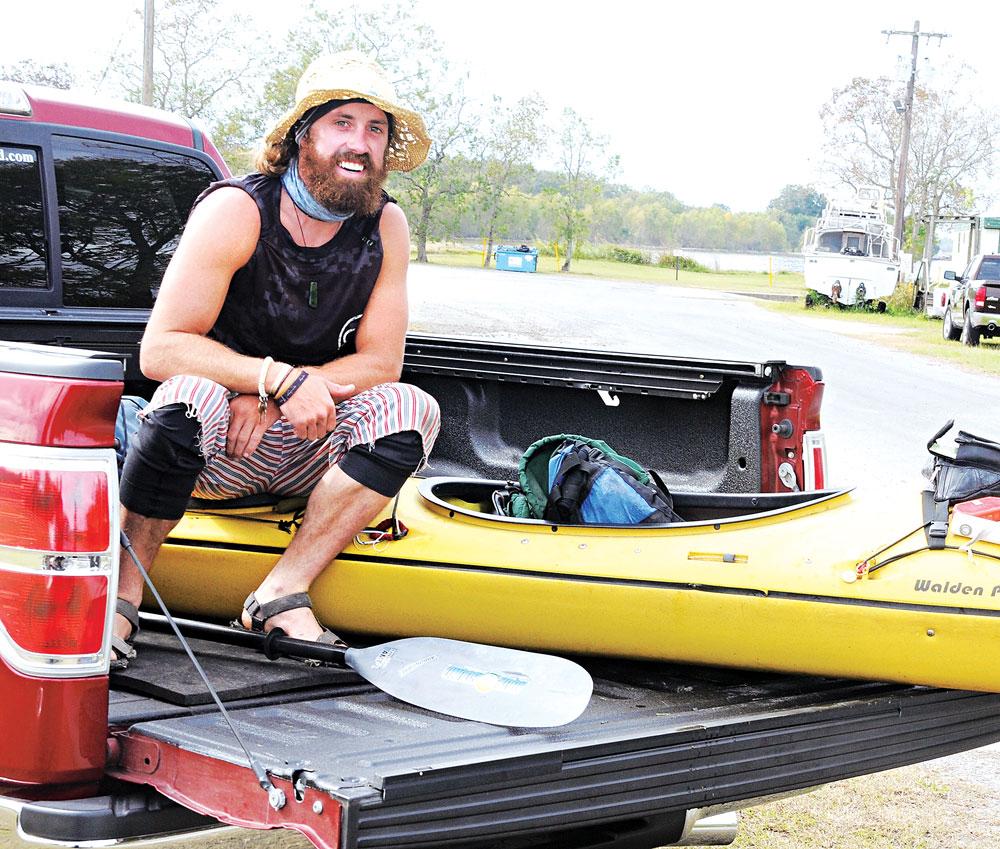
Especially around Thanksgiving, but every day, too, Tyler Wood is thankful to be alive. He isn’t stopping there.
The 27-year-old began the kayak portion of a monumental adventure Oct. 9 in his hometown of West Lafayette, Indiana, and plans to finish the 1,700-mile segment Dec. 1-3 in Houston.
He stopped Monday, Nov. 19, in Morgan City while kayaking the Intracoastal Waterway. He’s also traveled on the Wabash, Ohio and Mississippi rivers during his trip.
The kayaking part is just the first section of a continuous grueling journey also composed of sailing, bicycling and hiking expeditions that he plans to complete in April or May 2020 at the southern end of South America.
Ever since graduating high school, Wood has been a guide for kayaking, backpacking and camping trips in different places in the United States, Canada, Guatemala, Australia and New Zealand.
Four years ago, his life and chance to explore nearly ended.
In 2014, Wood suffered a traumatic brain injury after a severe car crash in New Zealand. Ninety percent of people who suffer that type of injury spend the rest of their lives in a coma.
“I’m extremely blessed to be able to get out here and challenge myself every day,” he said.
“Any of these people that are in the 10 percentile of survivors from the brain injury, they’re learning how to walk, talk and eat again. Where I am so blessed to be able to do these things,” Wood said.
He attributes his rapid recovery to prior experience of pushing himself out of his comfort zone in the outdoors. His good fortune motivates him “to live a bit more for the present.”
“It’s so fun going into a different world every single day and the unpredictability of who you’re going to meet,” Wood said.
Almost exactly a year after his horrible crash, he started hiking the over 2,600-mile Pacific Crest Trail from Mexico to Canada. He raised about $10,000 during that trek for traumatic brain injury survivors who struggle in daily life.
He began dreaming about the current journey he’s on ever since his Pacific Crest Trail hike.
Raising funds for others “was so valuable,” but it also added a lot of pressure to the trip, he said.
So this time, he decided to not try to raise money and “really just focus on the journey itself.”
Wood has “always been a nature boy.” He grew up as an only child in the middle of the woods building forts, running up and down ravines and climbing trees.
He enjoys the simple existence of only carrying what he can fit in a kayak, backpack or on a bicycle.
He’s trying to test all the skills he’s learned, push himself to physical limits, inspire others and “see the beauty in humanity,” Wood said.
“People that have nothing, they will offer me everything that they have,” he said of his experience thus far.
When he gets to Houston, Wood intends to sell his kayak and buy a bicycle. He then hopes to get a ride on a sailboat or “get a ride somehow, some way across the Gulf of Mexico” and into Mexico, he said.
Once he gets to Mexico, he wants to ride his bicycle to Santiago, Chile. Lastly, he expects to walk another roughly 1,700 miles along the Greater Patagonian Trail all the way to the bottom of South America.
“I love the simplicity of backpacking. Having this kayak with me, it’s getting annoying,” he said with a laugh. “I’m ready to sell it.”
Despite his significant amount of experience in the outdoors, leaving for this trip is “the most courageous thing I’ve ever done,” Wood said.
The trip, so far, has greatly tested him, and he’s cried and screamed “in absolute misery fighting against whitecap waves on the Mississippi for miles and miles and miles.”
Yet he knows he can grow by challenging himself.
To follow his journey, go to his Facebook and Instagram pages, wanderwood18. He records a regular video journal on his Facebook page.