
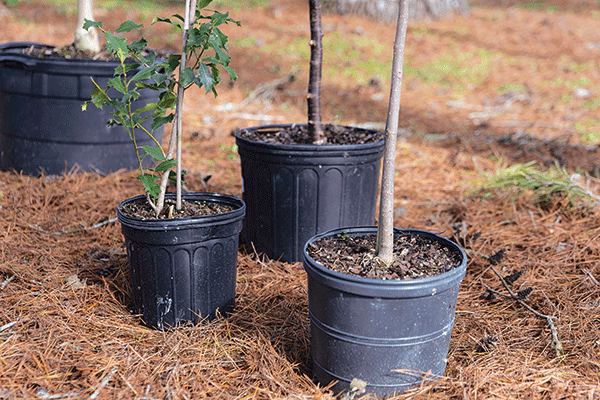
If you’ve ever looked up the date for Arbor Day, you may have run into some conflicting information. Nationally, this holiday celebrating the importance of trees is observed on the last Friday of April. But in Louisiana, we have our own Arbor Day: the third Friday of January, which this year is Jan. 17.
Why the discrepancy? In Louisiana, January tends to be a cool, wet month, providing ideal conditions for planting trees. By April, things are already warming up here, and it’s important to allow trees time to start getting established before the hot summer arrives.
Planting a tree, whether on your own property or in a public space as part of an Arbor Day event, is a wonderful way to mark the occasion. Trees help local wildlife and ensure future generations have shade to enjoy. You may even decide to plant a tree as a memorial to a loved one.
With a few exceptions, you can plant just about any type of tree right now in Louisiana. Just hold off on certain fruit and ornamental trees — like olives and figs — that are native to warmer tropical climates.
Before selecting a tree, do your research on mature sizes of different species. Choose a tree that isn’t too big for your yard and that won’t pose any hazards to your home.
Even if you don’t have a lot of room, you can still get in on the tree-planting action. Many small trees are available, and any size tree can have a positive impact on both the environment and the aesthetics of your landscape.
Crape myrtles are a great, widely used tree for small spaces, but there are plenty of alternatives. Some of LSU AgCenter horticulturist Jason Stagg’s favorite small trees include:
Vitexes. These small trees put on a stunning display of purple flower spikes each May and June. A second flush sometimes follows in July and August. A popular cultivar that grows well here is Shoal Creek, a Louisiana Super Plant selection that has larger, more vibrant blooms than other vitexes.
Taiwan cherries. These are some of the most reliable early spring-blooming trees in Louisiana. Sporting dark pink blooms on bare branches as early as late January, these trees also produce small red fruit that appeals to wildlife.
Deciduous magnolias, also known as Japanese or saucer magnolias. Many of us are familiar with these trees’ pink to purple blooms, which appear in late winter and early spring. Newer cultivars — such as one called Butterflies — that feature yellow flowers are now hitting the market. Many deciduous magnolias form smaller, rounded canopies while yellow-flowered varieties tend to have a tight pyramid shape as they grow — so they won’t take up too much space.
Hollies. Native holly species such as the American holly offer a dependable evergreen option in the landscape. Female plants produce red berries, which not only are visually pleasing but also serve as a wildlife food source. American holly trees can reach up to 40 feet tall but will keep a space-saving pyramid form.
Now, when it comes to planting a tree, the process is simple. Dig your planting hole twice as wide as the diameter of the container and only as deep as the height of the container.
This second part is crucial: If you plant your tree too deeply, the soil will smother the base of the trunk, which is an important gas exchange point that facilitates respiration. Other consequences include greater chances of root girdling and the potential for root rot due to poor drainage. If your hole is too deep, your tree is at much higher risk of dying.
Water your newly planted tree well. Cover the planting area with 2 to 4 inches of mulch, which will help retain moisture, suppress weed growth and insulate tree roots.
It takes a few years for trees to establish, and during this time, they need to be watered regularly, especially during hot or dry periods. Make sure to choose a planting site where water is easily accessible.
Arbor Day is upon us. Plant a tree and make a difference.
Get It Growing