Right past the dock on Calcasieu Lake, Megan La Peyre stared at an ominous rain cloud she and her team were driving straight into.
On this boat, La Peyre, an adjunct professor at the LSU AgCenter and unit leader of the U.S. Geological Survey Louisiana Fish and Wildlife Cooperative Research Unit, was joined by Seth Blitch, the director of conservation for the Nature Conservancy in Louisiana. While the rain could have dampened the mood, both researchers knew that it was simply a nuisance. They were going to get wet anyway.
On a second boat — with cargo that included boxes, scales and scientific equipment — Jeff Plumlee, a fisheries specialist with the AgCenter and Louisiana Sea Grant, led a group of graduate students and an extension agent to a hidden but deceptively large destination: an artificial oyster reef.
The reef is one of three in Calcasieu Lake, among a few other sites in Louisiana and Mississippi that were developed with the help of The Nature Conservancy and the AgCenter. The other sites in Louisiana are near Grand Isle and Vermilion Parish and the sites in Mississippi are near Pearl River and Biloxi. The reefs in Cameron Parish were first placed in 2017, when La Peyre first began working toward researching and developing a “living shoreline” along the lake.
“We’re looking to recruit oysters because, in Calcasieu Lake, this area is a good oyster-producing area. So, The Nature Conservancy went out and made these reef bases that were based on a mix of some shell and lots of rocks,” La Peyre said. “When the oysters reproduce every year, they have a place that they can settle and then they grow. And this happens over the year, multiple years. And so you get a living shoreline.”
The reef bases La Peyre mentioned are metal gabion baskets filled with limestone, concrete and rebar structures, according to The Nature Conservancy’s website. The structures give ideal living conditions for oysters and promote recruitment on these baskets.
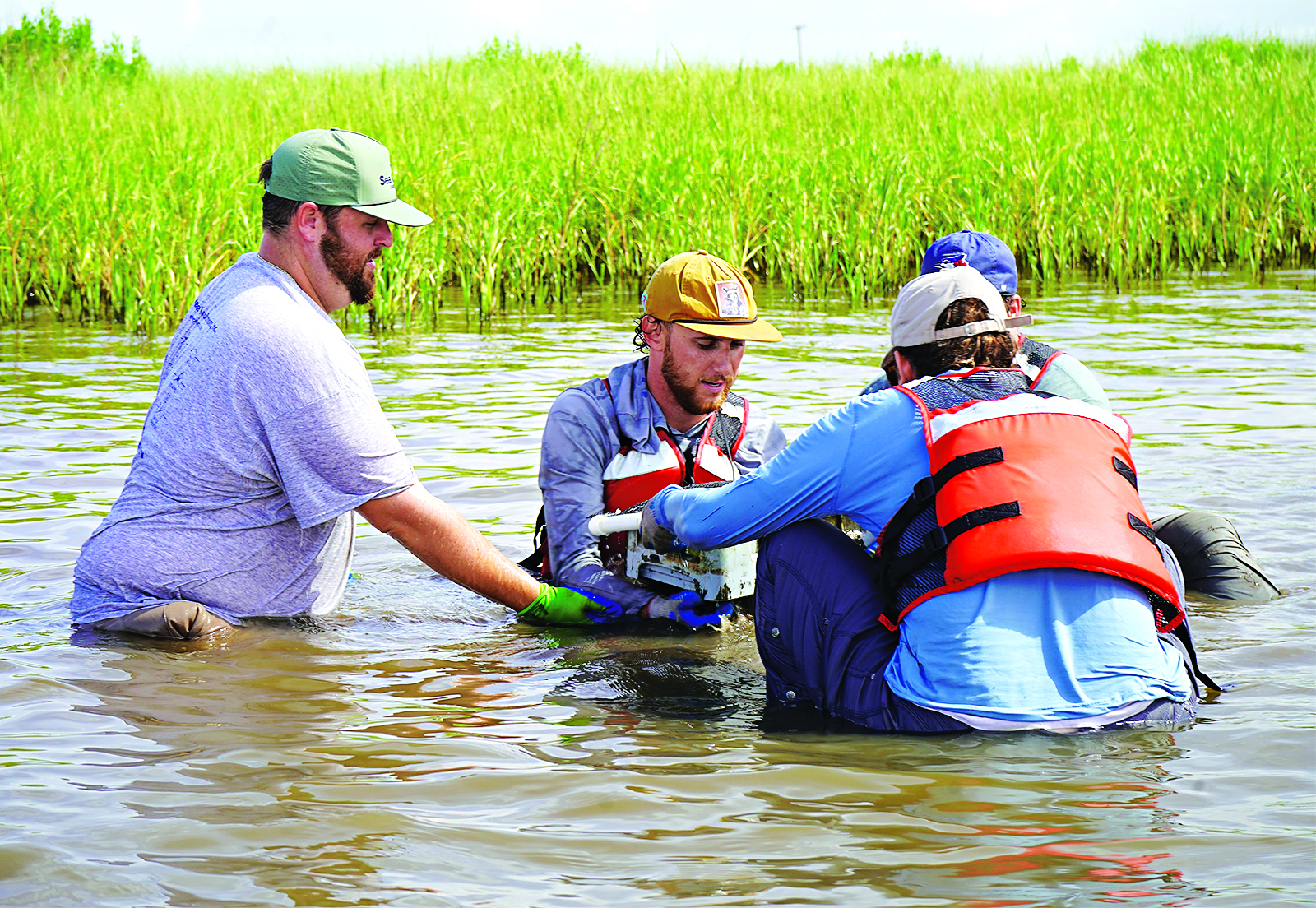
At the reefs, the researchers collected samples from the reef to compile data on how large the oysters and mussels are as well as estimate how many are on the reefs. To do this, they waded through the water and dug through the murky lake to find clumps of the reef that could be easily taken and observed. They also did a few tests on the water, including depth and salinity.
Once the oysters and mussels reproduce and begin to live on these structures, they break down the limestone and begin turning it into a “living reef.” The lake and surrounding areas see many benefits that help more than just oysters, Blitch said.
“Oysters are filter feeders and so they actually can maintain and improve water quality. They create really complex structural habitat,” Blitch said. “It’s great for all kinds of estuarine species that spend all or part of their life histories around oyster reefs, where they can either forage or find refuge.”
Some of these species include different fish that are found in the lake, like trout and redfish. Fish are drawn to the living reefs because of the benefits they can obtain by living and feeding around it.
“Fish need structure. Fish really like structure,” Plumlee said. “What oysters provide is a structure for fish to accumulate on and grow and feed on.”
The reefs also create natural barriers for Cameron Parish, as they can help depreciate the strength of floodwaters and storms as they head inland. This helps the parish protect its infrastructure and industry, especially the factories and roads that are on and around Calcasieu Lake.
“The reef actually builds in resilience to the adjacent shoreline. This project is entirely the Sabine National Wildlife Refuge, which like anywhere in Louisiana, is experiencing land loss,” Blitch said. “We know from the data that since the project’s been there, the rate of shoreline losses has slowed down and, in some places, stopped. And we’ve actually been able reclaim some that shoreline, which is an unusual thing in the state.”