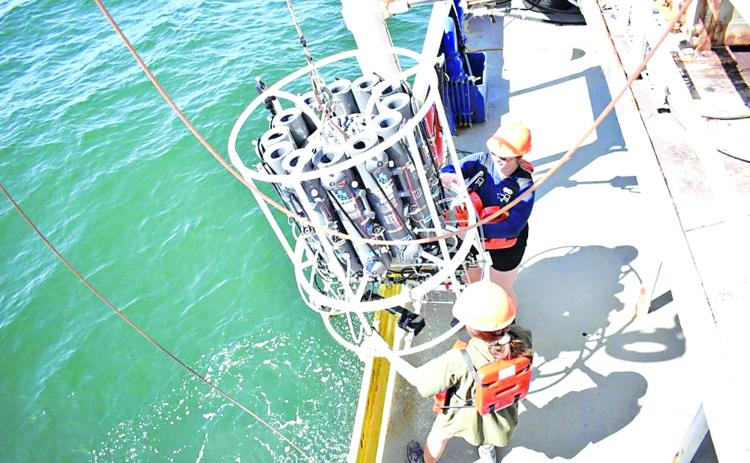
Students Abby Roche and Lily Tubbs retrieve the conductivity, temperature, depth sensor package after profiling dissolved oxygen at a station on the Louisiana Universities Marine Consortium Shelfwide Hypoxia Cruise. (Photo by Cassandra Glaspie | LUMCON/LSU)
The Gulf’s “dead zone” has shrunk significantly this summer, with scientists measuring a hypoxic area of just over 4,400 square miles — roughly a third smaller than last year and far less than the long-term average, federal officials announced July 30. The dead zone, a stretch of oxygen-depleted water that forms annually off the Louisiana and Texas coasts, is caused primarily by excess nutrients w…