
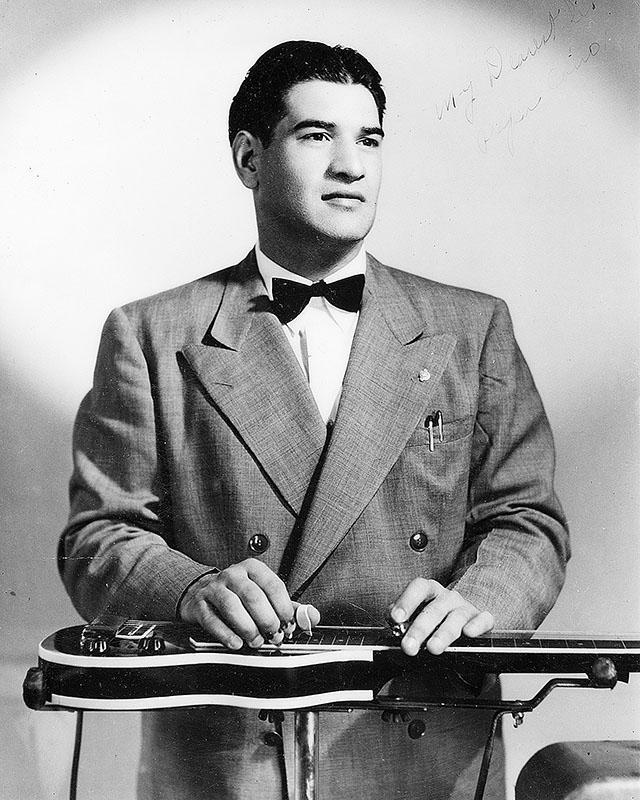
When you think of Hank Williams, many people in Louisiana remember his major hit song “Jambalaya.” However, it may never had happened if it weren’t for Crowley native who spent most of his music career trying to get the song popularized.
He became one of the region’s largest “sidemen” in the local music scene but few people remember him; lost among the bigger names such as Happy Fats, Joe Falcon and Joe Werner. He was Julius Angelle Lamperez, a steel-guitar playing boxer and World War II veteran that recorded for both national labels as well as independent Louisiana record producers.
Most remember him by his nickname: Papa Cairo.
The Early Years
Papa was born on July 27, 1920, and was adopted by Adonis and Elena “Birdie” Lamperez in New Orleans shortly afterwards. His father was a World War 1 veteran that had served overseas and had suffered from being gassed in the trenches on the European front.
Returning home, Prohibition had gained momentum and Adonis did what he could to make a living. He ran into trouble with the law multiple times moving bootleg liquor and got caught running a “blind tiger” saloon when Papa was only 6 years old. Yet, through this turbulent upbringing, Papa began to acquire a musical talent.
Western swing music of Texas was always Papa’s favorite. He grew up listening to bands such as Light Crust Doughboys, but Jimmie Rodgers was his idol.
“I just figured it out,” he told historian Kevin Coffey. “Didn’t have nobody around. No musicians at all. The first musician I heard was Jimmie Rodgers and ‘All Around The Water Tank’.”
So, with very little money, he went to work building his own guitar from scratch.
“I got me a big box. My buddy got a neck and put it on there. I got a knife, I cut in and made me a bar. I used just a straight pick and he used part of a telephone for a pick-up. Man, that sounded good! And he made me a homemade amplifier. Two tubes!”
The first place he played was at the Tee Maurice in Bosco. He recalled that the only people he could remember playing Cajun music in the area was accordionist Joe Falcon and the Breaux family; jokingly referring to their instrument of choice as the “swamp organ.”
Always a big talker, people who knew him remembered him to have a larger-than-life reputation.
Outside of music, as a youngster, sports were his main interest, especially football and boxing. Among his boxing friends and family, he claimed he never lost a bout!
As a young teen, he mastered the guitar, occasionally dabbled in playing the fiddle, until 1935, when he stated, “I got commercial.”
When he was around 15 years old, Papa formed a makeshift musical group in Crowley known as the Daylight Creepers. Among the members were two brothers Bill and Hanky Redlich, drummer Leonard Campbell and guitarist Irby Thibodeaux. It even featured young guitarist named Jay Denton “J.D.” Miller and, at one point, had Leo Soileau playing with him.
Miller explained, “The band’s name was brought about originally because they had an old Model-T Ford and every time we’d go to a dance, we’d get back home at daylight.”
Not only did his group play on KVOL, they played in the same dancehalls as more notable bands such as Happy Fats’ Raynbo Ramblers, the Hackberry Ramblers, and Joe Werner.
Over time, he would become familiar with all of the local musicians, filling in on guitar from time to time.
Miller recalled, “We didn’t make much money, but we had a lot of fun.”
Everything changed when he got a chance to pick up a nickel-plated resonator guitar, commonly referred to as a Dobro. After getting a chance to watch Bob Dunn of the Texas Wanderers at a dance in Mermentau, Papa was immediately enamored by the instrument and purchased one. From that moment on, the Hawaiian lap steel guitar would be his identifying instrument.
Eventually, he was good enough to land a spot on radio station KVOL in Lafayette.
Alons Kooche Kooche
By 1937, guitarist and showman Joe Werner of Crowley had made a name for himself as a string band artist playing alongside the Hackberry Ramblers. Werner and fiddler Wayne Perry acquired a deal with Decca Record’s A&R scout David Kapp for a recording session and the duo picked up Papa Cairo to fill out the group. Together, they would be billed as the Louisiana Rounders.
That year, Decca had arrived in Dallas and was looking for traveling bands to record. The company’s talent roster already contained hillbilly singer Jimmie Davis, Derwood Brown’s country swing band, and even Cajun musicians Joe and Cleoma Falcon.
Joe, Wayne, and Papa recorded a slew of songs, including two on which Cairo sang, “Valse A Papa” and “Alons Kooche Kooche” — a song about a small community near Mermentau named “L’anse Kooche Kooche.”
He remembered, “During the recording sessions, we made so much noise tapping our feet on the floor we had to take off our shoes.”
Having kicked off his recording career, little did he know that his “Kooche Kooche” melody would inspire one of the biggest country music hits after World War II.
Back home playing at places such as the Avalon Club, he was introduced to singer and songwriter Leroy “Happy Fats” Leblanc, fiddlers Oran “Doc” Guidry and Harry Choates.
“The first fiddle player we had around here who could really play (Cajun music) was Doc Guidry,” Papa said. “The second one was Harry Choates. He was a fine musician.”
As a vibrant showman, he introduced himself as “Papa,” signifying he was the first, therefore, the best steel guitarist in Cajun country. Legend has it that Happy Fats, while working alongside him, had noticed he always had a carreau (or “diamond”) stickpin attached to his necktie. From then on, he was popularly known as Papa Cairo.
He found himself filling in from time to time with their groups, the Rayne-Bo Ramblers and the Sons of Acadians, for different events. It would be at one of those events in which FSA photographer Russell Lee documented his early performances.
While on stage, Lee snapped one of the most iconic photos of Papa playing his lap steel guitar at the 1938 Rice Festival. As audiences gazed at his playing, he’d take his hands off the instrument, keeping the notes going with feet on the pedals, amazing the crowd.
He continued filling in as a sideman for other bands in the region, playing in many of the popular clubs.
“One of the biggest places there was, more people, was in Breaux Bridge, The Wild Cherry. The best club and the biggest club we had back in the ‘30s. People used to come in buses – school buses,” Papa said. “ And one of the biggest before that was the O.S.T. in Rayne. And before that, the Tee Maurice.”
It was in these places where he met the swing fiddle players that he admired.
By 1940, he had a chance to record with Happy Fats and Harry Choates in Dallas. When he came back, he landed other gigs at dance halls like Bourque’s in Lewisburg, Hank’s Place in Church Point, the Showboat in New Iberia, and especially the Green Lantern and Step Inn Club in Lawtell.
“(Those) were two clubs and they were both almost full every Saturday night...played for Senator Cleveland back in the ‘40s.”
One of the biggest groups he joined in with was Leo Soileau’s Rhythm Boys. Leo wasn’t so much amazed by his playing, but more amazed that Papa was constantly selling himself and his music… and how sober he remained.
“He’d play all night on two Coca-Colas. No high ball, no nothing. That’s one boy that didn’t drink,” Soileau said.
But for Papa, the selling of the music was all business.
“I never drank, never smoked, never drank coffee. Why? Money. I love money,” he exclaimed.
It wouldn’t be long before both Happy and Harry borrowed his signature melody for their RCA recording of “Grand Prairie.” Although recording opportunities ceased during the war, Papa would remain with Happy Fats’ band until late 1943.
World War II
He met his second wife, Bessie Short, in Texas, and shortly after, they took a trip to Arkansas to get married. But, within a few months, he was called into service.
With World War II in full swing, Papa headed to the induction center in Lafayette and enlisted in Army on September 19, 1943.
He was awarded two purple heart medals and four bronze stars for the four battles he fought.
Soon after the war, he took a job working at an oxygen plant in Memphis, Tennessee.
“He didn’t think he could continue playing music anymore,” said Margie.
The pause was brief and eventually changed his mind. Once he got back to Crowley, he picked up right where he left off, landing gigs at places like Quincy Davis’ Avalon Club, the Pleasure Club with Leo Soileau’s group, and Speedy’s Broken Mirror alongside Harry Choates Melody Boys band.
After Harry Choates had landed his hit single “Jole Blon” in 1946, Quincy had Choates playing in his club and Harry would have Papa join his boys.
“Me and Harry and them, we played every night we could…and they used Nathan Abshire.”
His band could be found playing near Ruston, opening for Jerry Lee Lewis, and for a brief time, he toured with Ernest Tubb. He boasted that he was the only one to play a triple steel guitar and called himself the “fastest steel in the south!”
Big Texas
By 1948, he settled down and found steady work with a local group in Eunice. He joined forces with Chuck Guillory’s band, the Rhythm Boys, featuring Curzy “Pork Chop” Roy, Herman Durbin, and a young unknown vocalist named Jimmy Newman.
While playing at a club in Eunice that year, he and Chuck were spotted by music mogul Joe Bihari — producer for the Los Angeles-based record company, Modern Records.
The Bihari brothers had surprising success two years earlier marketing Harry Choates’ recording of “Jole Blon” and were scouring the Gulf Coast for more Cajun talent. Bihari convinced Guillory and his band to head to New Orleans and record two songs.
Realizing his opportunity, Papa resurrected his “Kooche Kooche” tune and retitled it “Big Texas.” The flipside contained Jimmy Newman’s very first recording entitled “Chere Petite.”
The record sold moderately well for the Biharis, however, it became a local sensation for Chuck’s band throughout Louisiana, turning the tune into Chuck’s own theme song.
During this time, Papa also played at places such as the Lake Shore in Lake Arthur, Hester’s Bar in Crowley, Silver Slipper Club in Eunice, Pleasure Club, Welcome Club in Crowley, Hollywood Club in Rayne, Beacon Club in Crowley.
By 1949, Papa was now on the radio again. He became a staple of the Rice Festival each year and appeared on a recurring program on the local radio station KSIG.
Young artists who were making their way into the country scene either played in Papa’s band or vice versa, such as Cajun swing guitarist Francis “Red” Fabacher, Cajun-country musicians Rusty and Doug Kershaw, fiddler Murphy Smith, and Cajun fiddler Rufus Thibodeaux.
While performing with Chuck in Bridge City, Texas, he met George Jones.
“George Jones worked for me even before he had a band,” Papa said. “We let him sit in with our band. Later, when my group was playing in Vidor, Texas, Jones asked to join the group. I told my guitar player, one day, ‘That boy’s gonna do well in the music business’.”
He told Coffey, “Many musicians either worked for me or against me! I worked everywhere. You name it.”
But he never traveled far. He quickly realized all the opportunities to perform were right here in South Louisiana.
“Why I didn’t go to Nashville? I’m gonna tell you. I’d make $200-$300 every night.”
However, his decision to stay home rather than jump into the limelight with bigger stars would eventually cost him.
Towards the end of 1949, the Bihari team had created a new label called Colonial and headed straight to KSIG in Crowley to re-record Chuck’s group that January. The Biharis had a hunch that Chuck and Papa would sell well in Texas, Louisiana, and maybe Mississippi.
This time, Papa had already branched out into his own group which included many of Chuck’s band members. With Murphy Smith on fiddle, Albert Roy on guitar, Hermin Durbin on piano, Curly Mertz on drums and Don Lane on xylophone, Papa’s group landed four tunes during a session at J.D. Miller’s studio downtown.
Trying to reach a wider audience, he re-recorded “Big Texas” as “Big Texas #2,” this time in English with credits to Papa Cairo And His Boys. He even used the opportunity to re-record his original “Kooche Kooche” on the record’s flipside.
For the first time, he was going make sure the tune was firmly in his control, both with recording and marketing.
By 1951, before Papa could market his new recording, bad luck struck again. The Bihari brand was changing yet again and the Cajun music venture with Colonial was a failure.
Chuck had continued on with his group, replacing Papa with Red Fabacher on steel guitar and added a young vocalist named Marty Robbins.
Frustrated by its lack of success and relieved of his contract with the Biharis, Papa convinced J.D. Miller to quickly re-record his tune, both in English and French, again on his fledgling Feature label. He used every chance to market his song, bringing his band to play on KSIG and at different festivals such as the Kaplan Fair, Bunkie Corn Festival, Petroleum Festival, Louisiana Dairy Festival in Abbeville and, of course, Crowley’s Rice Festival.
Meanwhile, a young star of the Grand Ole Opry, Hank Williams, was dominating the radio waves of the country music scene. In June of 1952, Hank (possibly with the help of Moon Mullican) used the “Big Texas” melody and wrote the classic tune known as “Jambalaya.”
How Hank discovered the melody is shrouded in mystery.
Big Bill Lister explains that Mullican and Williams composed “Jambalaya” together while traveling in Hank’s limo on the way to a show in Louisiana and that Don Helms (Hank’s steel player) wrote the words down. Big Bill Lister said: “We stopped and Don Helms got a sheet of cardboard and Hank and Moon banged that thing back and forth, and Don wrote it down.”
Another theory is that Happy Fats, who had played on the same billing as Hank at the Louisiana Hayride, helped Hank compose the song. Nevertheless, on Sept. 6, 1952, Hank’s “Jambalaya” had reached first place on the Billboard Country Songs and it remained on there for 14 weeks.
Furious, Papa immediately claimed that Williams stole his tune. When music writer Mike Leadbitter asked him what happened, he explained that after “Jambalaya,” he was too disgusted with the recording industry and vowed never to record again. Even though he gave his family a bogus reason for quitting the recording industry, people like his daughter Terry always knew the truth.
“He was a big hunter and fisherman,” Terry said. “He told me he didn’t want to record anymore because it would mess up his hunting and fishing. But I think he was upset about Hank doing that, and he never really trusted the music (recording) business after that. He was done with it.”
Shortly after, Marty Robbins left Chuck’s band and eventually re-recorded one of Papa’s other songs, “You Just Wait And See,” into his more famously well-known “Pretty Words.”
Papa remained in music the rest of his life. He continued to perform live shows including, many benefit dances. In 1953, he got a chance to play alongside Cliff Bruner at Crowley’s International Rice Festival. In 1954, his group began playing in Galveston, Texas, where, over the next 10 years, he found steady work, usually in small restaurants and cafes such as the 12th Street Inn.
Around the same time, he landed other long-term performance contracts through the ‘50s and ‘60s.
“I had a 12-year contract at the Silver Slipper — Monday, Thursday, Saturday and Sunday. Then I’m working the Lake Shore Club. Same thing, I had a 12-year (contract)…every Friday night. And every Wednesday night I’m working at the Silver Star on Old 90 between Lake Charles and Sulphur,” Papa said.
Back home in Crowley, he led a quieter life, staying out of most public events. He raised cattle at his ranch near Cecilia throughout the 1960s.
In the late 1970s, he continued to perform, usually as a guest performer at festivals and charity events alongside Pee Wee Trahan and Hanky Redlich. By 1989, he regrouped with Chuck Guillory for a brief time, playing dancehalls like Boo Boo’s Bar in Rayne and appearing at the New Orleans Jazz Festival.
On Aug. 17, he was inducted in the Cajun French Music Association Hall of Fame.
(Information for this article was obtained from http://arhoolie.org/leo-soileau-interview/; interviews by Kevin Coffey / Kevin Coffey Collection; John Broven’s “South to Louisiana: The Music of the Cajun Bayous”; Ryan Andre Brasseaux’s “Cajun Breakdown: The Emergence of an American-Made Music”; Colin Escott’s “Hank Williams: Snapshots From The Lost Highway”; Mike Leadbitter’s “Blues Unlimited” The Acadian-Signal; The Crowley Daily Signal; The Ruston Daily Leader; John Broven’s “Record Makers and Breakers: Voices of the Independent Rock ‘n’ Roll Pioneers”; Terry Lamperez interview)