
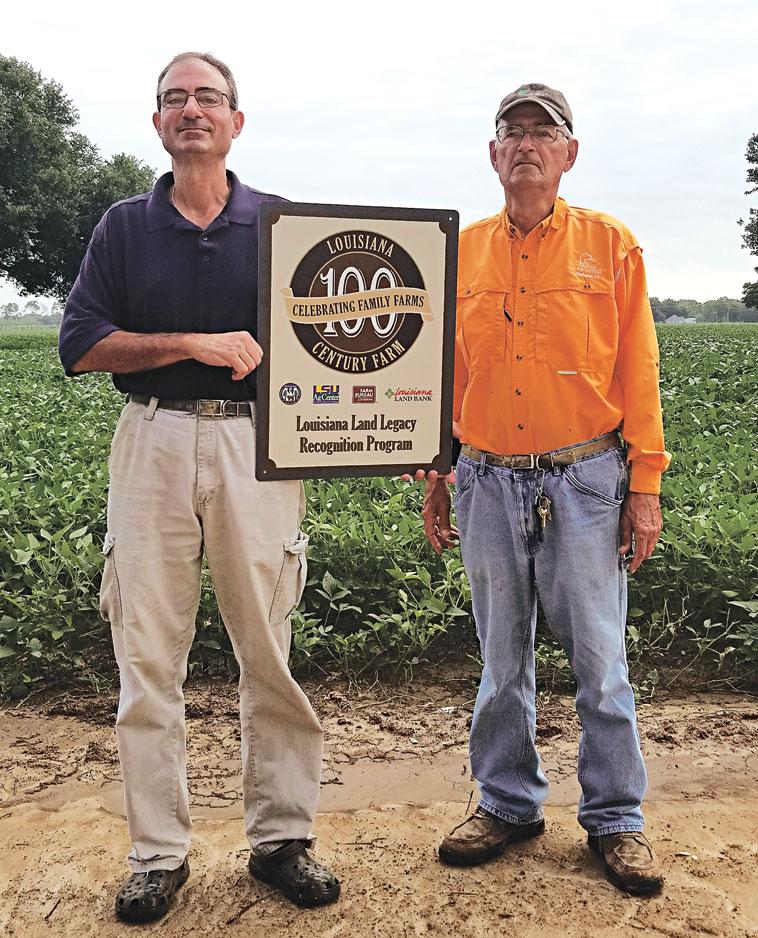
Patrick DeJean’s family, past and present included, knows how to hold onto things, including precious mementos of family history and especially farmland.
Patrick DeJean, of Plaisance, said, “In 1929, W.C. DeJean, my grandfather, was named a Master Farmer of Louisiana by the State. I have the newspaper article, the picture of W.C., his wife and all of the kids and the Farmer of the Year medal.”
He continued, “When I went to work at the Department of Public Welfare in Opelousas in 1961, my boss said that her daddy was the one that wrote the article on W.C when he got the award, and she gave me her father’s notes from the story.”
Holding on to things — like the nearly 90-year-old interview notes — is what recently earned DeJean Family Farms the Louisiana Century Farm Award. Four generations of DeJeans have kept and consistently farmed about 74 acres of W.C.’s farmland on La. 35 near Lewisburg.
The award is administered by the Louisiana Department of Agriculture and Forestry and the LSU AgCenter, and it is bestowed upon families who have owned and consistently farmed on Louisiana land for at least 100 years. In addition to the interview notes, the DeJean’s have the handwritten receipt from the first 113 acres of farmland W.C. purchased on Nov. 27, 1916, and 74 of those acres are the ones that remain in the family name today. The property has a Church Point address.
DeJean Family Farms was one of six farms to receive the award this year. The farm was the only St. Landry Parish farm to get the award this year and only the third in the parish to ever receive the award.
The award winners were announced earlier this summer at the 96th Annual Louisiana Farm Bureau Federation convention in New Orleans. Since 2014, 59 farm families have received the Century Farm Award.
LDAF Commissioner Mike Strain, D.V.M. said, in a news release, “What do these family farms mean? It’s about our families, traditions, our past and our future.”
Ronnie Anderson, president of the Louisiana Farm Bureau Federation, said, in a news release, “This is one of the most unique awards because it truly proves the resiliency of family farms.”
According to the Master Farmer story on W.C. DeJean that ran in the St. Landry Clarion on April 11, 1929, “It all started with one old horse, $200 in cash, good health and a vision of owning a home and a good farm.”
DeJean said, “When I lived down there — I grew up across the street — my grandfather had six or seven half tenants. That’s where the landlord furnishes the land, all of the equipment, the seed — everything — and a house for the tenant. Generally, he would also back him up financially. At the end of the crop, half went to the landlord and half went to the tenant. As these tenants got a team of mules or got a little tractor — had their own equipment and stuff — their share of the rent was a third.”
He continued, “My grandfather had all these different pairs of mules and all the plows, and all that. Every morning, the tenants would come and gather. First they fed the animals. They fed them in the morning, and they fed them in the evening. They would get everything ready, and take off. My grandfather would follow different ones on horseback all the time.”
In 1948, ownership of the farm was passed down to Patrick’s father, Joseph Archie DeJean.
“Then my father took over running the place, and he would more or less do the same thing,” he said. “He had his own horse. My grandfather was still alive. He lived to be pretty old. Of course, my daddy lived to be even older. My dad was 97 when he died. W.C. was in his 80s when he passed away.”
DeJean said his father was very active in the Yambilee Festival, always exhibiting a crate of sweet potatoes at the event, and DeJean has a box of his father’s blue ribbons and grand champion ribbons. DeJean himself, along with some of his cousins, also grew sweet potatoes, and he was also active in 4-H.
“Lewisburg had all kinds of potato kilns,” DeJean said. “They also had a dehydrating plant for all your potatoes that had weevils or were defective or stuff you couldn’t sell. They would come out in bulk and put it in barrels to feed the pigs. It smelled. All of the that area was sweet potatoes at that time.”
During his years as a farmer, DeJean said he has seen the challenges and changes of the farming industry.
“Farming is a rough business right now, like the price with soybeans, and your equipment is out of sight,” he said. “Then you get everything perfect, and there’s no rain or it rains too much.”
DeJean said the ability to find local labor has also declined gradually over the years.
“We built our house here (in Plaisance) in the ‘60s, and there was always somebody driving in (saying), ‘Y’all have anything we can do today or tomorrow or whatever, you know, but we need some work.’ We always had cattle, fencing or whatever. Now, you can’t get anyone. We have to search for labor.”
Even with the ups and downs of the business, DeJean said his least favorite farm fact has nothing to with equipment, weather or finding labor.
“I can tell you what I enjoyed the least — milking cows,” he said, laughing.
DeJean continued, “There is always something to do. There is something to do all the time. That’s what keeps me farming.”
“In fact, there’s projects here that don’t ever get finished,” he added, laughing.
In 1995, DeJean became owner of his grandfather’s land, and in 2000, the land became part of DeJean Family Farms LLC — DeJean, his wife, Gwen, and their three children, Charlotte A. DeJean, William Bart DeJean and P. Yvette DeJean.
DeJean Family Farms now includes more than 800 acres of farmland, including the 74.11 acres left of W.C.’s original purchase. W.C.’s tract is currently used for sugarcane, and over the last century, the DeJean’s have also farmed soybeans, corn, wheat and cattle.
William DeJean said he did the research to make sure the land had been in the family for 100 years, and he said it was he and his siblings’ idea to apply for the Century Farm award.
“Dad found out about it (the award) whenever we got him to sign his name on the documents for submission,” DeJean said.
“He might have not known what he was signing, but he knew it wasn’t a check so, he didn’t have as much problem with that,” he added, laughing.
William shared his reaction to receiving the award.
“After a hundred years of this — I’m in my 50s and Dad was born in 1939 — the award is a recognition, but it’s all the time that you put into it and holding onto it. Everything moves on — the crop in the field, waiting to make sure there’s not a drought, and now we’ve had rain.”
He continued, “His grandfather, who worked and saved his money and bought it (the land) and kept it up for all those years, and the fact that it didn’t change hands with his father and him, they have done all the work (to earn the award).”
.