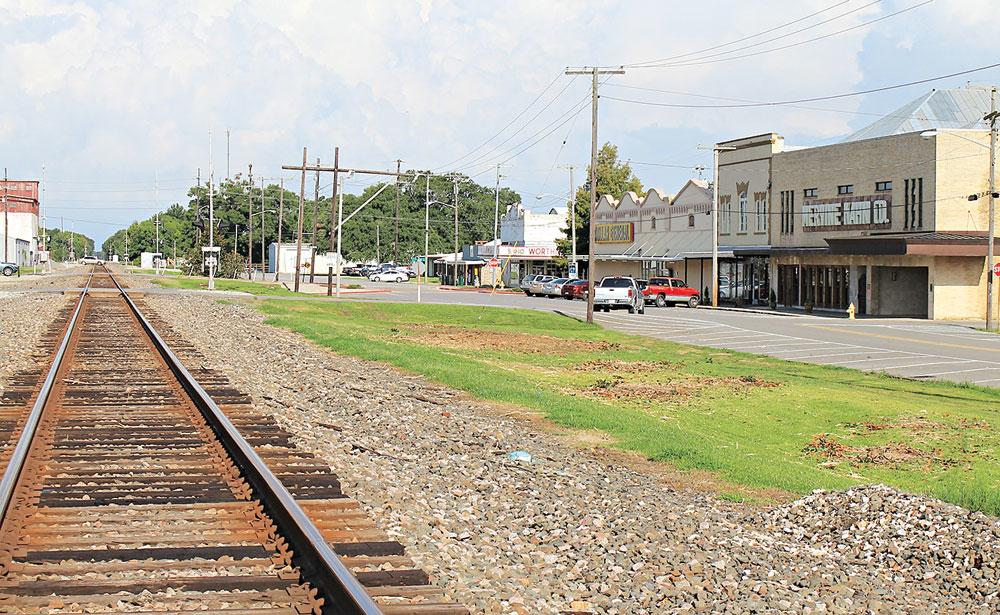
What began as a community-wide project for the improvement of downtown Rayne abruptly ended, compliments of the railroad.
Situated between Louisiana Avenue and the railroad tracks that run east and west through the city, the Magnolia Memorial Park was established in May 2012 by numerous donors and volunteers with the purchase and planting of over 30 magnolia trees, each varying in height, variety and price.
The planting of the trees, each purchased by families in memory of loved ones, was completed three years ago, with plans for phase two and three set to begin to include a walking path, benches and shrubbery as noted by project co-chairs Elaine Wooley and Martha Royer.
All that came to an abrupt halt Wednesday morning when vehicles and equipment with Grayhawk Midwest of Aurora, Illinois, a company contracted by BNSF Railway Company, arrived and began the heart-wrenching job of cutting and disposal of 23 of the original trees.
“We tried our hardest to have this not happen,” said Mayor Charles “Chuck” Robichaux Wednesday afternoon. “But, it being the property of the railroad, they are entitled to do with it as they feel fit, and I guess they felt this was their only option.”
In their communication, BNSF stated the tree removal was considered a safety issue at at-grade crossings (railway and street intersections). BNSF specified a 50-foot right-of-way edge was needed for safe travel at selected crossings throughout the state.
“It’s a little deeper than ‘we’re cutting down trees in Rayne,’” said Hoseph Faust, director of public affair for BNSF. “This is a vegetation removal project. We’re following guidelines set up by the Federal Railroad Administration.”
The trees represented a safety hazard, according to Faust.
“The trees are in close proximity to a railroad crossing. In order to protect the citizens, we have to have a good line of sight.
“The crossings in Rayne have lights and gates, but are not protected from people wanting to ‘snake around’ the gates or from pedestrians who may be walking across the tracks.”
Faust said removing the trees will give train crews “an additional line of safety.
“When the crews come through the community, they will be able to see vehicles or pedestrians.”
Robichaux said, “Sure, we would have transplanted them elsewhere in the city,” Robichaux stated. “We have plenty of room around the city the trees could have been placed. But with the time constraints the railroad gave us, along with the hot, summer heat, I doubt the trees would have survived if transplanted at this time.”
That’s why they were planted in the fall and spring when they were initially planted and were surviving, and were even thriving until today.
“I feel sick to my stomach this happened. I purchased one of the larger trees myself in memory of my parents. Now it’s gone.
“I’m not sure what the rush was of the tree having to be removed at this time. All we needed was a couple months to transplant them when the temperature would be cooler. Our pleas fell on deaf ear.”
Many objections were heard throughout the city once word was spread of the trees being cut. Most of all, from Royer and Wooley.
“I still can’t believe this has happen to our downtown area,” said Royer while watching the trees being leveled. “So many people have worked so hard in the planning, donations and efforts by many. There’s no reason for this to happen.”
Wooley concurred, “Do you know how many people this affects? So many families purchased trees for their family members. It just breaks my heart.”
Ranging from $90 to $375, trees were purchased by many families in memory of their loved ones in time for the park dedication in January of 2013. Later that month, the Rayne Garden Club, in a joint effort with Bob’s Tree Preservation Company, donated 17 additional magnolias during their annual Arbor day ceremony.
The park was created with a two-fold purpose: to memorialize and honor residents who are no longer with us and to assist in providing clean air and noise reduction for the downtown area.
Former Rayne mayor and current Acadia Parish Assessor James “Jimbo” Petitjean, under whose administration the project was begun, said he was surprised to learn of the railroad’s actions.
“This was all worked out while this project was still in the planning stage,” Petitjean said. “Southern Pacific agreed to allow this project and the city would upkeep the trees and surrounding property. Not sure what this is all about.”
BNSF Railway noted no record of the agreement between the city and the railroad company was on file.
“As you know, the railroad has been operating in that area for close to 150 years,” said Faust. “There may have been some kind of agreement with the predecessor rail company, we don’t know. We could not find any kind of contract.
“Unfortunately, those trees were planted on BNSF right-of-way, which extends about 100 feet in either direction from the center of the tracks — more or less in some areas,” Faust continued.
“I cannot stress enough that this is for safety reasons ... protecting the safety of the people in that community. It takes a train going 50 mph over a mile to stop and, unlike a vehicle on a street, a train cannot swerve to avoid a collision.”
But, not all is lost -- a half-dozen trees remain between North Cunningham and North Parkerson, in addition to three across the street from Worthmore’s just west of North Adams Ave.
Royer and Wooley both agreed, “Looks like we will have to transfer these trees, also. You never know if the railroad will decide next month or next year to chop those down, too.
“We will catch our breathe, make another game plan and get back to work. The people of Rayne deserve better than that,” Royer said as they both looked towards the empty property that laid filled with tree mulch and magnolia leaves.