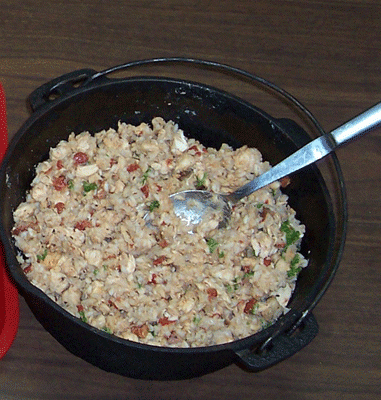
A controversy in the White House? That’s hardly news. Over jambalaya? Maybe.
If you missed it, White House chefs prepared a rice dish listed on the menu as “jambalaya” for a big shindig when French President Emmanuel Macron came to call. But guests from Louisiana said that the dish was “just rice” and didn’t have chunks of chicken or sausage or seafood required to make the jambalaya they knew.
“Au contraire,” cried the chef, who said the dish had tasso and andouille in it, but it was chopped so fine the diners couldn’t see it. The goal, according to the White House, was “for the dish to look cohesive” with “all components about the same size, unlike the rustic … version where the sausages are left bigger and more obvious.”
Nonetheless, Sen. John Kennedy, who attended the dinner, stuck by his guns and maintained that the rice dish “was very good,” but that it wasn’t anything like jambalaya.
All of which caused me to pull out some old cookbooks to see what they had to say about what jambalaya is or isn’t. I didn’t find a hard and fast rule.
Elizabeth Bégué, who was famous for her cooking in the late 1800s, and who the New Orleans Picayune called “Queen of the Culinary Arts,” offered two jambalayas in a compilation of some of her favorite recipes (Mme. Bégué’s Recipes of Old New Orleans Creole Cookery, Pelican Publishing). Her “Jambalaya of Rice and Shrimp” combined boiled shrimp and fried rice, seasoned with onion, salt and pepper, thyme and parsley. Her “Jambalaya of Chicken” used chicken and ham fried in lard combined with rice, onion and tomato, seasoned with salt, “strong pepper,” bay leaves, parsley, and thyme.
Lafcadio Hearn, who studied and wrote about the ways and culture of New Orleans in the 1870s and 1880s, especially loved the food he found there and compiled a recipe book in 1885 (Lafcadio Hearn’s Creole Cook Book, Pelican Publishing). His “Jambalaya of Fowls and Rice” calls for ham and chicken without a lot of seasoning. No tomato.
Hearn wrote that “Southern children are very fond of [jambalaya]; it is said to be an Indian dish, and very wholesome as well as palatable.” And, important for this discussion, he wrote that jambalaya “can be made of many things.”
More recent food writers such as Paige Gutierrez (Cajun Foodways, University Press of Mississippi), agree with that assessment, writing that “Jambalaya is probably even more variable than gumbo; virtually any combination of meats and seafood may be used, along with the usual seasoning vegetables and ham or sausage.”
Mary Lamb spent a lifetime collecting “treasured old recipes,” in the words of New Orleans restaurateur Owen Brennan, and put them together in a book that many people still consider the bible of south Louisiana cuisine (Mary Lamb’s Louisiana Cookery, LSU Press). She also seems to agree that there are many ways to make jambalaya. Her book offers recipes for “Cajun Jambalaya,” “Poule d’Eau Jambalaya,” “Rabbit Jambalaya,” “Camp Jambalaya” (in which you can use “any small birds or game”), and “Oyster Jambalaya” (which also includes slices of salt pork).
(Her poule d’eau instructions begin with “skin two coots and remove all fat,” which I thought might be a good beginning for anything cooked up in Washington, but we’re talking food here, not politics.)
Her jambalaya recipes all give the impression that they are essentially hunting and fishing camp cuisine, and, in fact she quotes Arthur Van Pelt, described as “the dean of all Louisiana’s outdoor writers,” as the expert on the proper way to prepare jambalaya Cajun-style.
“This is not a mixture of boiled rice and gravy as is frequently served under the name of Jambalaya,” he said. “Instead it is the completed product of the skillful blending of many flavors of which none predominates. It should be cooked in a big iron skillet.”
My first thought was that Arthur might have offered a clue; that the way it is prepared might be just as important— or maybe more important — than the ingredients in making something called jambalaya. But then I read his remarks again and realized that the thing that sets off all south Louisiana cuisine, not just jambalaya, is “the skillful blending of many flavors” and we do that blending more than half the time in a big iron skillet. He could be talking about anything.
All of which brings me back to where I started. If the White House cook wants to hide the andouille and still call the dish jambalaya, who are we rustics to argue?
But if President Macron should come to my house, he’ll get sausage he can see and that will stick to his ribs.
A collection of Jim Bradshaw’s columns, Cajuns and Other Characters, is now available from Pelican Publishing. You can contact him at jimbradshaw4321@gmail.com or P.O. Box 1121, Washington LA 70589.