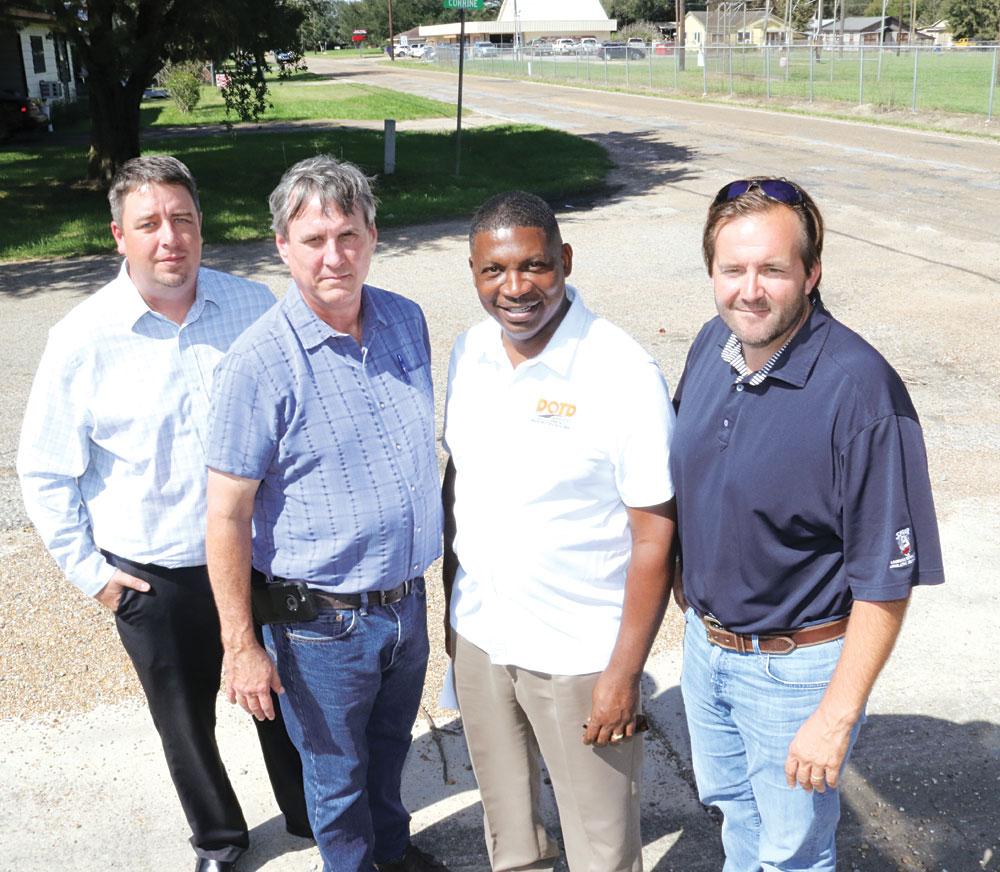
On the side of Maple Avenue at Champagne’s, Dr. Shawn Wilson, secretary of the state Department of Transportation and Development, stepped out of state Rep. Phillip DeVillier’s SUV to talk about roads and bridges on Friday.
About bumpy Maple Avenue, Wilson said. “Every project that we have is an issue of time and money and does it reconcile. There is some absolute needs here. The representative and I have been talking about a number of things. Everything from capital outlay to surplus funds to the regular program to the gas tax.”
DeVillier said, “I think it is always positive when you can get the secretary of DOTD to come down and look at what our infrastructure priorities are for the district. They can actually see it versus just hearing about it.”
Accompanying Wilson and DeVillier were Mayor Scott Fontenot and Bill Oliver, district administrator.
Wilson noted the regional district has about 2,400 miles of road “he’s got enough money to do about 20 of those a year.”
He added, “When you get into the details of of those, when you look at the cost, look at the functionality of the road, that makes decision-making all the more challenging and just speaks to the challenges we have in the state.”
Wilson also stressed the need for bridges. “I tell people bridges are much more important than people think because you can have a great road with a bad bridge and you get nowhere.”
On Thursday, the Judson Walsh bridge leading to Opelousas Senior High School was closed, he said, and it may remain closed for up to a year.
Main thoroughfares are always a priority, he said. But some rural roads have not been touched in 15 to 20 years, he said.
“So, in talking to leaders here, Maple is a critical footprint for them.”
The transportation’s total budget is just short of $2 billion annually, he said, but its revenues have not kept up with inflation when it comes to road and bridge development and maintenance.
The department is funded by a 16 cent a gallon tax, which has been in place since 1989, he said.
“It is worth about 7 today and the cost of construction has gone up 15, 20 percent,” he said. Operations and maintenance costs also have increased, he said.
“Everything has increased except the revenue stream hasn’t kept up with inflation,” he said.
The state is even having difficulty meeting federal matches, which have gone from 90-10, 80-20 to now sometimes a 50-50 split, he said.